
LED Lighting: What is a Foot Candle & How is it Measured?
- 2024-03-26 14:48
- UNITOP
If you've ever tried to upgrade your facility's lighting, you've probably encountered three confusing terms: watts, lumens, and foot candles. Most business owners know watts measure electricity use, and many have learned that lumens indicate brightness. But foot candles? That's where things get murky, and that confusion leads to expensive mistakes—like installing fixtures with impressive lumen ratings that still leave your workspace uncomfortably dark.
Here's the reality: lumens tell you what a light fixture produces, but foot candles tell you what your employees actually experience at their workstations. A warehouse might have fixtures pumping out 50,000 lumens each, but if those foot candle readings at floor level don't meet standards, you've got a safety problem and an OSHA citation waiting to happen.
This guide explains foot candles in practical terms for commercial LED lighting projects. You'll learn what foot candles measure, how to measure them correctly, what levels different facilities need, and how to avoid the common mistakes that waste money and create lighting problems.
A foot candle measures one lumen of light per square foot of surface area. It's the standard unit for measuring light intensity in commercial and industrial facilities across the United States.
What is a Foot Candle?
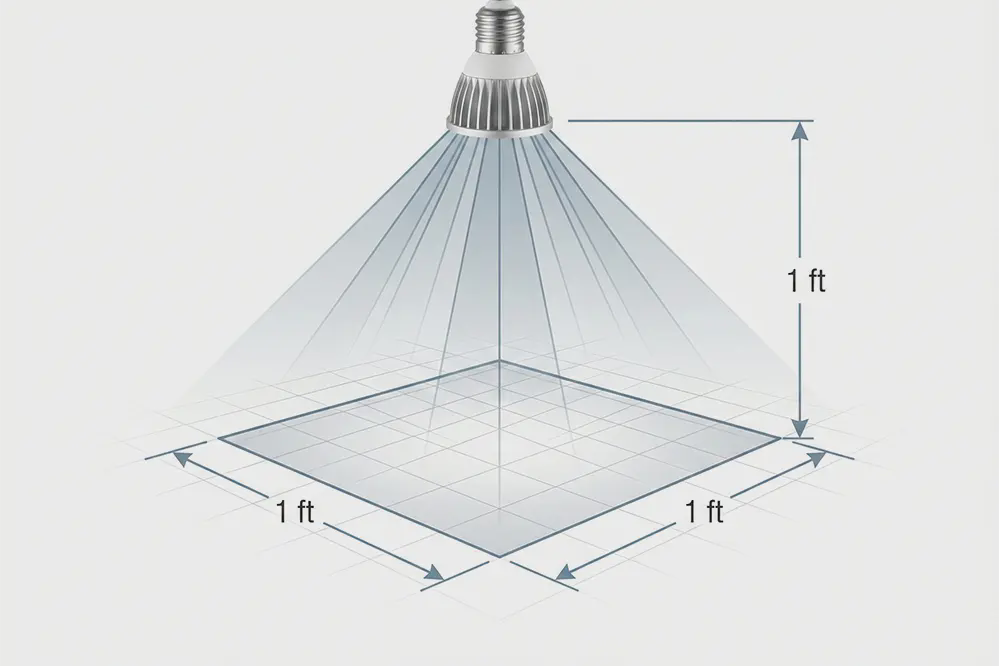
A foot candle (abbreviated fc, lm/ft², or ft-c) measures the amount of light reaching a surface. Specifically, one foot candle equals one lumen of light spread across one square foot of area.
The term dates back to when candles were the primary light source. Engineers defined one foot candle as the amount of light cast on a surface one foot away from a standard candle. While we've moved far beyond candles, the measurement stuck because it's practical and intuitive.
Today's technical definition describes a foot candle as the illuminance on a one-square-foot surface from a uniform light source. The measurement focuses on received light (what hits your desk or warehouse floor) rather than emitted light (what leaves the fixture).
Commercial lighting professionals in the United States use foot candles as their standard measurement for three reasons. First, it directly measures what people experience in a space rather than fixture specifications. Second, building codes and safety standards reference foot candle requirements, not lumens. Third, the Illuminating Engineering Society (IES) publishes all their recommended lighting levels in foot candles, making it the industry standard for lighting design.
When you measure foot candles in your facility, you're answering the question: "How much usable light actually reaches the areas where people work?" That's different from asking how bright your fixtures are.
Foot Candle vs Lumens: Understanding the Difference
Lumens and foot candles measure two different aspects of lighting, and confusing them creates problems.
Lumens measure the total amount of visible light a fixture produces in all directions. When a manufacturer says their LED high bay produces 20,000 lumens, they're telling you the total light output leaving that fixture. Think of lumens as the source measurement—what the fixture generates.
Foot candles measure how much of that light actually reaches a specific surface. A fixture producing 20,000 lumens might deliver 50 foot candles to the floor directly beneath it, but only 10 foot candles to the corners of your warehouse. Foot candles are the destination measurement—what your space receives.
Why both matter: You need lumens to compare fixtures and calculate how many you need. You need foot candles to verify that your space actually meets lighting standards after installation. A contractor might promise "plenty of lumens," but only a foot candle measurement confirms adequate lighting at the work surface.
Here's a critical distinction that causes endless confusion: 1 foot candle does NOT equal 10.76 lumens. That's a myth based on misunderstanding the conversion to lux. One foot candle equals 10.76 lux (the metric equivalent), not lumens. You cannot directly convert foot candles to lumens because they measure different things. It's like trying to convert gallons per minute (flow rate) into total gallons (volume)—they're related but not interchangeable.
When planning LED lighting, you'll use lumens to select fixtures, then verify performance with foot candle measurements. One doesn't replace the other.
Foot Candle vs Lux: Imperial vs Metric
Foot candles and lux measure identical concepts—light intensity on a surface—but use different units of area.
A foot candle measures lumens per square foot (imperial system). One lux measures lumens per square meter (metric system). Since one square meter equals 10.764 square feet, the conversion formula is:
1 foot candle = 10.764 lux
1 lux = 0.0929 foot candles
For practical purposes, many lighting professionals round this to "1 foot candle ≈ 10 lux" when precision isn't critical.
The United States predominantly uses foot candles in commercial lighting. You'll find IES recommendations, OSHA requirements, and building codes all specified in foot candles. Most light meters sold in the U.S. display both units, letting you switch between them.
Internationally, lux is standard. European lighting specifications, many Asian markets, and scientific applications use lux exclusively. If you're working on international projects or using equipment calibrated to metric standards, you'll need to convert between the two.
The good news: modern light meters handle this conversion automatically. Set your preferred unit, and the meter displays readings accordingly. Just make sure you're comparing apples to apples—don't mix a foot candle requirement with a lux measurement without converting.
How to Measure Foot Candles
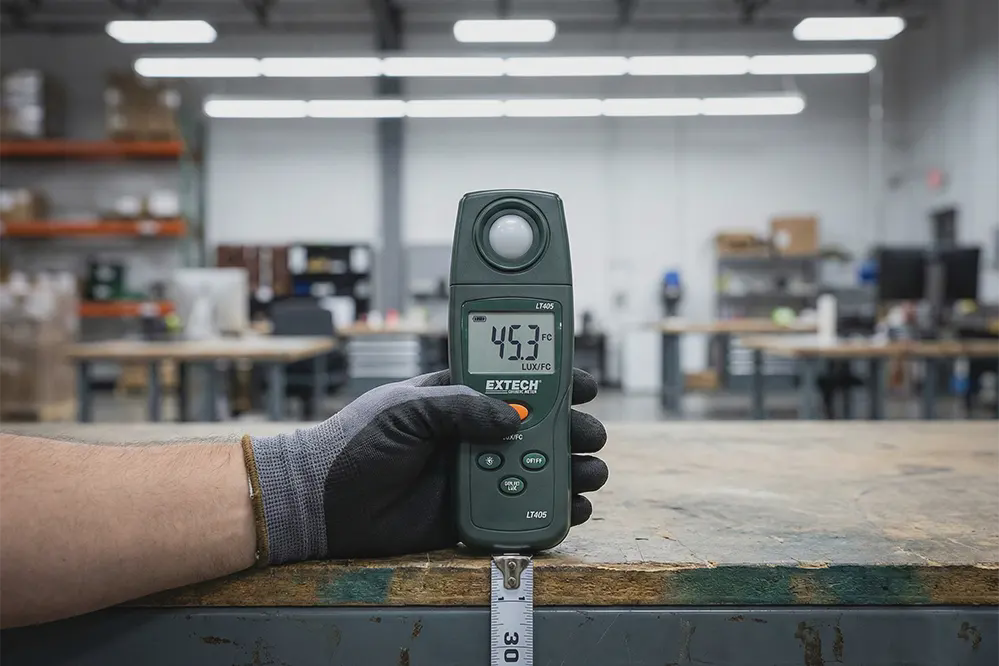
Measuring foot candles accurately requires the right equipment and proper technique. Here's the practical process for commercial facilities.
Equipment needed: You need a light meter (also called an illuminance meter or lux meter). For commercial applications, expect to spend $150-$400 for a reliable meter. Budget options around $30-$50 exist but often lack accuracy and calibration. Look for meters that:
Display both foot candles and lux
Have a cosine-corrected sensor (accounts for light angle)
Offer reasonable accuracy (±5% or better)
Include a detachable sensor for measuring tight spaces
Popular models for commercial use include the Extech LT300, Dr.Meter LX1330B, and higher-end options from brands like Konica Minolta or UNI-T.
Step-by-step measurement:
Power on the meter and select foot candle (fc) mode
Let the meter stabilize for 30 seconds
Clean the sensor—dust and fingerprints reduce accuracy
Place the sensor at the measurement location with the detector facing the light source
Hold the meter still until the reading stabilizes (usually 3-5 seconds)
Record the reading
Where to measure matters: Don't just measure at floor level unless that's specifically what you need. Different applications use different measurement planes:
Offices and desk work: 30 inches above the floor (standard work plane height)
Warehouses and aisles: Floor level for walking safety
Loading docks: 36 inches above the floor (typical work surface)
Retail displays: At the product display surface
Parking lots: Ground level
Take measurements at multiple locations, not just directly under fixtures. Measure in the areas farthest from light sources where levels are typically lowest. The IES recommends a grid pattern—for a warehouse, you might measure every 10-15 feet in a systematic pattern to understand uniformity.
Horizontal vs vertical measurements: Most foot candle requirements specify horizontal illuminance (light falling on a horizontal surface like a desk or floor). Vertical illuminance matters for specific applications like security lighting where you need to see faces clearly. Your light meter should be positioned accordingly—flat for horizontal readings, vertical for vertical readings.
Photometry vs radiometry: When you measure with a light meter, you're doing photometry—measuring light as the human eye perceives it. This differs from radiometry, which measures all electromagnetic radiation including wavelengths we can't see. Photometry matters for commercial spaces because you need to know what workers actually experience, not just the raw energy output.
Common mistakes to avoid:
Measuring in bright daylight without accounting for natural light
Holding the meter at the wrong angle (affects readings by 20-30%)
Taking a single reading and assuming it represents the whole space
Not allowing fixtures to reach operating temperature (particularly important for older technologies, though LEDs stabilize quickly)
Using an uncalibrated meter (accuracy degrades over time)
For critical applications or baseline measurements, consider hiring a lighting professional with calibrated equipment. Their measurements carry more weight with inspectors and provide documented proof of compliance.
IES Recommended Foot Candle Levels by Application
Understanding IES Standards
The Illuminating Engineering Society (IES) develops lighting recommendations used across the industry. Founded in 1906, the IES brings together lighting designers, engineers, architects, and manufacturers to establish best practices for illumination.
IES recommendations aren't legal requirements—they're expert guidance on appropriate lighting levels for different tasks and environments. The organization's "Lighting Handbook" (currently in its 10th edition) contains hundreds of pages of detailed recommendations based on research into visual performance, safety, and comfort.
Here's an important distinction: OSHA (Occupational Safety and Health Administration) sets minimum lighting requirements for workplace safety. These minimums are often lower than IES recommendations. OSHA requires 5 foot candles for general warehouse areas, but IES recommends 10-30 foot candles depending on the specific tasks being performed. Meeting OSHA minimums keeps you legal; following IES recommendations creates safer, more productive environments.
Why one-size-fits-all doesn't work: A 30 foot candle reading might be perfect for an office but completely inadequate for quality control inspection. IES tailors recommendations to specific tasks because lighting needs vary based on:
Visual difficulty of the task (reading fine print vs walking through a corridor)
Speed and accuracy required
Age of workers (older workers need 2-3 times more light for the same visual performance)
Contrast and reflectance in the environment
Duration of the task
The tables below provide commonly referenced IES foot candle ranges for commercial, industrial, and sports applications. These represent general guidelines; consult the full IES Lighting Handbook for your specific application.
Commercial Spaces
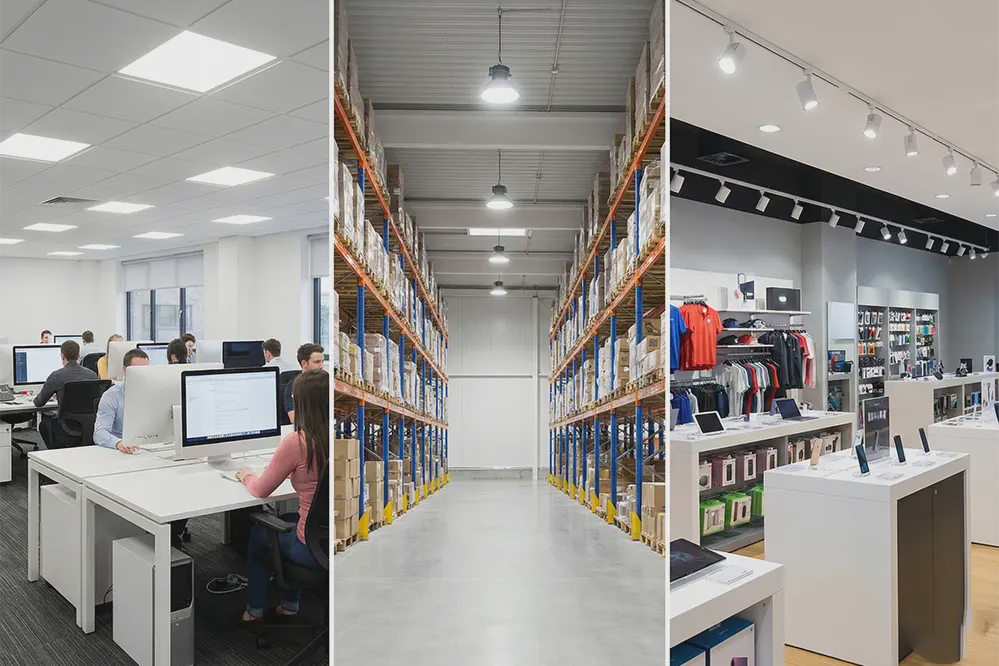
Offices: 30-50 fc for desk work, reading, and computer use. Conference rooms need similar levels with dimming for presentations.
Warehouses: Levels vary by activity:
Inactive storage: 5-10 fc
Active areas with large items: 10-20 fc
Medium items/order picking: 20-30 fc
Small items/parts: 30-50 fc
LED upgrades deliver consistent foot candles versus traditional metal halide systems that degrade 30-40% over time.
Retail: General circulation needs 20-30 fc, merchandise displays 50-100 fc, high-end displays 100+ fc.
Parking: Open lots need 2-5 fc average (5 fc at entrances), covered structures 5-10 fc. Target 4:1 uniformity ratio or better to avoid dark spots.
Data Centers: 30-50 fc for server aisles, 50-75 fc for repair areas.
Commercial Kitchens: General areas 50-75 fc, prep stations 75-100 fc, cooking stations 100-200 fc.
Healthcare: Hallways 5-30 fc, patient rooms 10-30 fc, nurse stations 30-50 fc, exam rooms 50-100 fc, operating rooms 100-200 fc.
Hotels: Lobbies and corridors 10-20 fc, front desk 50-100 fc, guest rooms 10-30 fc with task lighting.
Industrial Facilities
Manufacturing by Detail Level:
Coarse work: 10-30 fc
Medium detail: 30-50 fc
Fine detail: 50-100 fc
Extra fine/inspection: 100-500 fc
Assembly: 15-30 fc for simple tasks, 30-75 fc for medium precision, 75-300 fc for difficult/precision work, 300-600 fc for exacting assembly.
Inspection: Requirements vary by defect size—50 fc for large castings, 500+ fc for semiconductor inspection.
Maintenance Shops: 50-100 fc for equipment repair and tool rooms.
Loading Docks: 20-50 fc, with higher levels when verifying shipments or reading small labels.
Sports and Recreation
Gymnasiums: 30-50 fc recreational, 50-75 fc high school, 75-100 fc college/professional.
Outdoor Fields: 20-30 fc recreational, 30-50 fc high school, 50-100+ fc college/professional.
Tennis Courts: Indoor 25-120 fc, outdoor 20-100 fc (varies by competitive level).
Uniformity and glare control matter critically—a 30 fc average is meaningless if half the court measures 50 fc and half measures 10 fc.
Factors Affecting Foot Candle Requirements
Several factors influence how many foot candles a specific space actually needs. Understanding these helps you design lighting that works rather than just meeting numbers on paper.
Task complexity and visual detail: A worker walking through a warehouse corridor needs 5-10 fc to navigate safely. The same worker picking small electronic components needs 30-50 fc to see part numbers clearly. Match your foot candle target to the most visually demanding task performed regularly in that area.
Age of occupants: This factor gets overlooked constantly, but it matters. A 60-year-old worker needs 2-3 times more light than a 20-year-old to perform the same visual task with the same accuracy. If your workforce skews older, move toward the higher end of IES recommendations or add 20-30% to standard targets.
Surface reflectance: This is huge. Light bouncing off light-colored ceilings, walls, and floors contributes significantly to overall illumination. Dark surfaces absorb light, requiring more fixtures to achieve the same foot candle levels.
The IES recommends the 80/50/20 rule for commercial spaces:
Ceilings: 80% reflectance (white or very light colors)
Walls: 50% reflectance (light neutral colors)
Floors: 20% reflectance (medium tones)
A warehouse with white walls and light concrete floors might achieve target foot candles with 30% fewer fixtures than an identical warehouse painted dark gray. If you're planning LED upgrades, consider repainting dark surfaces—it pays for itself in reduced lighting costs.
Mounting height and fixture spacing: As mounting height increases, you need more lumens to deliver the same foot candles at the work plane. The relationship isn't linear—doubling the mounting height requires roughly four times the lumens to maintain the same illumination. Proper fixture spacing prevents dark spots between fixtures. The spacing-to-mounting-height ratio varies by fixture type, but 1.5:1 is common for even distribution.
Uniformity ratio (average to minimum): This is where lighting design separates professionals from amateurs. Uniformity ratio compares the average foot candle reading across a space to the minimum reading in the darkest spots.
IES recommends an average-to-minimum ratio of 4:1 or less for most applications. Tighter ratios (2:1 or 3:1) create more visually comfortable environments and are preferred for critical tasks. A ratio of 10:1 or worse creates uncomfortable contrast and dark zones that feel unsafe.
Example: If your warehouse averages 30 fc, the darkest spots should measure at least 7.5 fc (30 ÷ 4 = 7.5). If those dark corners only measure 3 fc, you've got a uniformity problem even though your average meets the requirement.
Glare control vs brightness: More foot candles isn't always better. Excessive brightness, particularly from poorly shielded fixtures, creates disabling glare that reduces visibility despite high foot candle readings.
Good lighting design balances adequate illumination with glare control through:
Proper fixture selection (appropriate shielding and optics)
Correct mounting height (higher mounting reduces glare at eye level)
Strategic fixture placement (avoiding bright sources in normal lines of sight)
A space with 40 fc and good glare control performs better than a space with 60 fc and glare problems.
Color rendering and perceived brightness: Foot candles measure quantity of light, not quality. Two spaces with identical 30 fc readings can look dramatically different if one uses 3000K (warm white) LEDs with 80 CRI and the other uses 5000K (cool white) LEDs with 90 CRI.
Higher color rendering (CRI 90+) makes spaces appear brighter and more comfortable at the same foot candle level. Color temperature affects mood—warmer tones (3000-3500K) create inviting retail environments, while cooler tones (4000-5000K) enhance alertness in work areas.
How to Calculate Lumens Needed from Foot Candle Requirements
Basic formula:
Lumens needed = Room area (sq ft) × Required foot candles
Example: 10,000 sq ft warehouse needing 30 fc requires 300,000 lumens total. With 20,000 lumen fixtures, that's 15 fixtures.
Why this fails: The formula assumes 100% efficiency—all light reaches the work surface, no losses occur, fixtures never dim. Reality is different.
Critical factors:
Light Loss Factor (LLF): Accounts for dirt accumulation (10-30% loss), lumen depreciation, and surface soiling. Typical LLF ranges from 0.7 to 0.85, meaning you need 15-30% more lumens than the basic calculation suggests.
Revised formula: Lumens = (Area × fc) ÷ LLF
Coefficient of Utilization (CU): Not all light reaches the work plane—some hits walls, gets absorbed, or escapes. CU typically ranges from 0.5 to 0.9 depending on room dimensions, surface reflectances, and mounting height.
Full formula: Lumens = (Area × fc) ÷ (CU × LLF)
Using CU 0.7 and LLF 0.8: 300,000 ÷ (0.7 × 0.8) = 535,714 lumens needed—that's 27 fixtures, not 15. The realistic calculation requires 80% more fixtures than the simple version.
When professional analysis matters: For projects over $20,000, facilities with complex layouts, or critical applications, photometric software (AGi32, DIALux) models exact conditions, accounts for obstructions, calculates point-by-point foot candles, and generates compliance documentation. Analysis costs $500-$2,000 but prevents expensive mistakes on $50,000+ projects.
LED Lighting and Foot Candles: Practical Applications
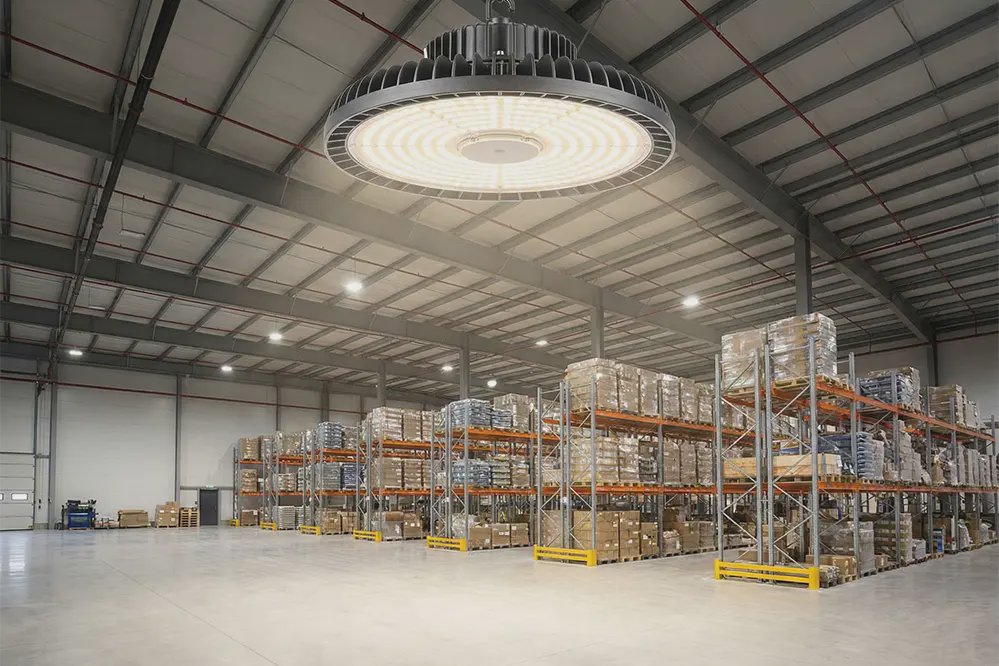
LED technology transformed foot candle planning for commercial facilities.
Reliability: Traditional metal halide varies ±15% lamp-to-lamp and loses 30-40% output over time. LEDs deliver rated lumens within 5% and maintain 90%+ output for 50,000+ hours. Your calculations actually match reality.
Instant full brightness: Metal halide needs 10-15 minutes warm-up. LEDs reach full output instantly, delivering target foot candles immediately.
Dimming and control: 0-10V dimming adjusts foot candle levels for unoccupied areas, daylight harvesting, and task tuning. A warehouse running 30 fc during operations can dim to 10 fc overnight, cutting energy 60-70%.
Energy efficiency: 40,000 sq ft warehouse targeting 30 fc might use 80 metal halide fixtures (32,000W) versus 65 LED fixtures (11,700W)—a 64% reduction. At $0.12/kWh for 4,000 hours annually, that saves $9,744/year.
Minimal light loss: LEDs maintain 90% output at 50,000 hours (L90 rating). Design closer to actual requirements without excessive over-design. To maintain 30 fc, metal halide requires designing for 42 fc initially; LED requires only 33 fc.
Color temperature: 4000-5000K appears slightly brighter than 3000K at equal foot candles. Commercial applications prioritizing visibility use cooler temperatures; retail spaces use 3000-3500K for warmer ambiance.
Common Foot Candle Mistakes in Commercial Lighting
Using lumens alone: Contractors install fixtures totaling impressive lumens but deliver inadequate foot candles due to poor beam angles, mounting height, or spacing. Always verify with actual measurements and require photometric analysis.
Ignoring uniformity: Averaging 30 fc means nothing if readings show 55 fc under fixtures and 8 fc between them. A 7:1 ratio creates dark zones and accidents. Proper fixture spacing prevents this.
Wrong measurement plane: Measuring at floor level when workers operate at 4-5 feet high misses the actual problem. Measure at the work plane height.
No light loss factors: Designing for exactly 30 fc leaves no margin for dirt accumulation and aging. Include 15-30% buffer to maintain targets over time.
Over-lighting: Delivering 60 fc when 30 fc suffices wastes 50% of energy and creates glare. Right-size your lighting.
Under-lighting: Saving money on fixtures creates safety risks, productivity losses, and OSHA violations worth far more than the energy savings.
Confusing OSHA minimums with targets: OSHA's 5 fc minimum is for legal compliance, not good lighting design. Use IES recommendations (typically 2-3× higher).
Uncalibrated meters: Budget meters vary ±10% or more. Use calibrated professional equipment for compliance verification.
Troubleshooting Foot Candle Issues
"It's still too dark": Check uniformity. You might average 30 fc but minimums of 6 fc create dark zones. Solution: Add fixtures to fill dark spots.
"Levels dropped after 6 months": Likely dirt accumulation. Warehouses and manufacturing facilities can lose 20-30% output to dust. Solution: Implement quarterly to annual cleaning schedules.
"Calculator says we're good but we're not": Online calculators miss your actual reflectances, obstructions, and real-world losses. Solution: Use photometric analysis for actual projects.
"Can't match competitor claims": They may measure differently or exaggerate specs. Solution: Compare actual foot candle delivery, not lumen claims.
"Same lumens, different brightness": Check color temperature and CRI. 4000K/90 CRI appears brighter than 3000K/70 CRI at equal foot candles. Solution: Match specifications across areas.
When to call a professional: Measurements differ wildly from predictions, adding fixtures doesn't help, compliance issues arise, or you're working with complex spaces or high-value projects.
FAQ
How many foot candles does OSHA require?
OSHA minimums: 5 fc for warehouses/corridors, 10 fc for loading platforms, 30 fc for construction shops. These are bare minimums—most facilities should target IES recommendations which are 2-4 times higher.
Can you convert foot candles to watts?
No. Watts measure power consumption; foot candles measure light intensity. Modern LEDs produce 120-150 lumens per watt while older metal halide produces 75-90 lumens per watt. You need fixture efficiency and installation details to connect the two.
What's the difference between average and minimum foot candles?
Average is the mean across all measurements. Minimum is your darkest spot. Both matter—30 fc average with 8 fc minimum means workers in dark areas lack adequate lighting. IES recommends 4:1 average-to-minimum ratio or better.
How do I know if I have enough foot candles?
Measure with a light meter on a grid pattern and compare to IES recommendations. Check both average and minimum values. Watch for worker complaints about eye strain or difficulty seeing details.
What light meter for commercial use?
Extech LT300 ($150-200) offers good value. Dr.Meter LX1330B ($40-60) works for spot-checks. Higher-end Konica Minolta or UNI-T ($300-500) provide better accuracy. Features needed: foot candles and lux display, cosine-corrected sensor, ±5% accuracy.
Do LEDs affect foot candle measurements differently?
No. Foot candles measure illuminance regardless of source. However, LEDs offer consistent output, stable performance, instant full brightness, and better directional control—making them more predictable.
How often should I measure foot candles?
New installations: immediately after completion. Ongoing facilities: annually. Dirty environments: semi-annually. After facility modifications or when lighting quality changes: re-measure immediately.
What's a good uniformity ratio for warehouses?
4:1 or better per IES. Tighter ratios (2:1 or 3:1) provide better quality. Example: 30 fc average should have minimums of at least 7.5 fc (4:1) or preferably 10-15 fc (3:1 to 2:1).
Why do measured foot candles differ from the photometric plan?
Common causes: different surface reflectances, unmodeled obstructions, fixture dirt, incorrect aiming, voltage variations, measurement error. Differences of ±10% are normal; investigate if exceeding 15%.
How does mounting height affect lumens needed?
Dramatically. Doubling mounting height requires roughly four times the lumens. A 20,000 lumen fixture at 15 feet might deliver 40 fc; the same fixture at 30 feet delivers only 10 fc. Always factor mounting height into calculations.
Conclusion
Foot candles measure what actually matters in commercial lighting—the usable light reaching surfaces where people work, not just the light leaving fixtures. Understanding foot candles transforms lighting from guesswork into engineered performance.
Here's your three-step action plan for better facility lighting:
Step 1: Measure current levels. Invest in a decent light meter ($150-300) or hire a professional for baseline measurements. Document foot candle readings throughout your facility on a grid pattern, noting both averages and minimums in each area. Identify problem zones where levels fall below requirements or uniformity suffers.
Step 2: Compare to IES standards. Match your measurements against IES recommendations for your specific applications. Don't settle for OSHA minimums—they're bare-bones safety requirements, not targets for good lighting. If you're below IES recommendations, you're likely experiencing reduced productivity, increased errors, or safety concerns even if you meet legal minimums.
Step 3: Plan strategic upgrades. LED technology makes lighting upgrades financially attractive through energy savings, reduced maintenance, and better performance. Focus first on areas with the largest gap between current and target foot candles, or areas where poor lighting creates safety risks or quality problems. Require photometric analysis for projects over $20,000 to ensure designs deliver promised foot candle levels.
The benefits extend beyond compliance. Proper lighting improves safety (fewer accidents and injuries), reduces energy costs (60-75% savings with LED upgrades designed to correct foot candle levels rather than over-design), and increases productivity (workers perform tasks faster and more accurately with adequate lighting).
For complex commercial projects, lighting retrofits involving significant fixture counts, or situations where code compliance and documentation matter, professional lighting design pays for itself. A $1,500 photometric analysis prevents $15,000 mistakes in fixture selection, placement, and quantity.
Ready to improve your facility's lighting? Start with measurements. You can't manage what you don't measure, and foot candles are what you need to measure.