
What Is Lux? Complete Guide to Light Measurement for LED Projects
- 2024-03-27 20:25
- UNITOP
Facility managers know this frustration well. You order LED fixtures advertised at 10,000 lumens, expecting brilliant illumination. The installation goes smoothly. Then reality hits: work surfaces remain dim, employees complain about eye strain, and productivity suffers. What went wrong?
The problem wasn't the fixtures. The problem was focusing on the wrong measurement. Lumens tell you how much light leaves the source, but they say nothing about how much light actually reaches the surfaces where your people work. That's where lux comes in.
Lux measures the amount of visible light that lands on a surface, expressed as one lumen per square meter. This single measurement transforms lighting decisions from expensive guesswork into precision engineering. Understanding lux means you'll never waste money on inadequate lighting again.
What Is Lux?
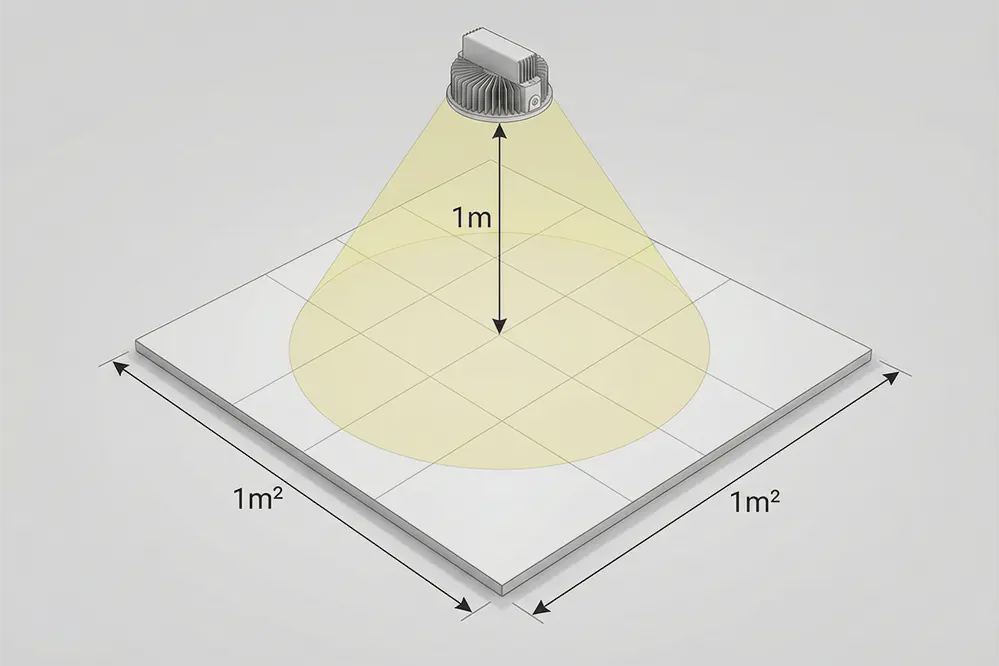
Lux is the standard unit of illuminance in the International System of Units (SI). One lux equals exactly one lumen per square meter. The term comes from the Latin word for "light," which is fitting given how fundamental this measurement is to proper lighting design.
While LED technology has revolutionized energy efficiency, even the most advanced fixtures fail without proper lux planning. You need to know not just what your lights can produce, but what actually arrives at desk height, assembly stations, or warehouse floors.
Think of it this way: if you pour 1,000 lumens of light onto one square meter, that surface receives 1,000 lux. Spread those same 1,000 lumens across ten square meters, and each square meter gets only 100 lux. The light source hasn't changed, but the user experience has changed dramatically.
This matters for commercial LED projects because manufacturers advertise total lumen output. They tell you the fixture produces 15,000 lumens, which sounds impressive. But if that light spreads across a 500-square-meter warehouse floor from 8-meter-high ceilings, the actual lux at ground level might fall far below safety requirements. Lux tells the real story.
The Critical Difference Between Lux and Lumens
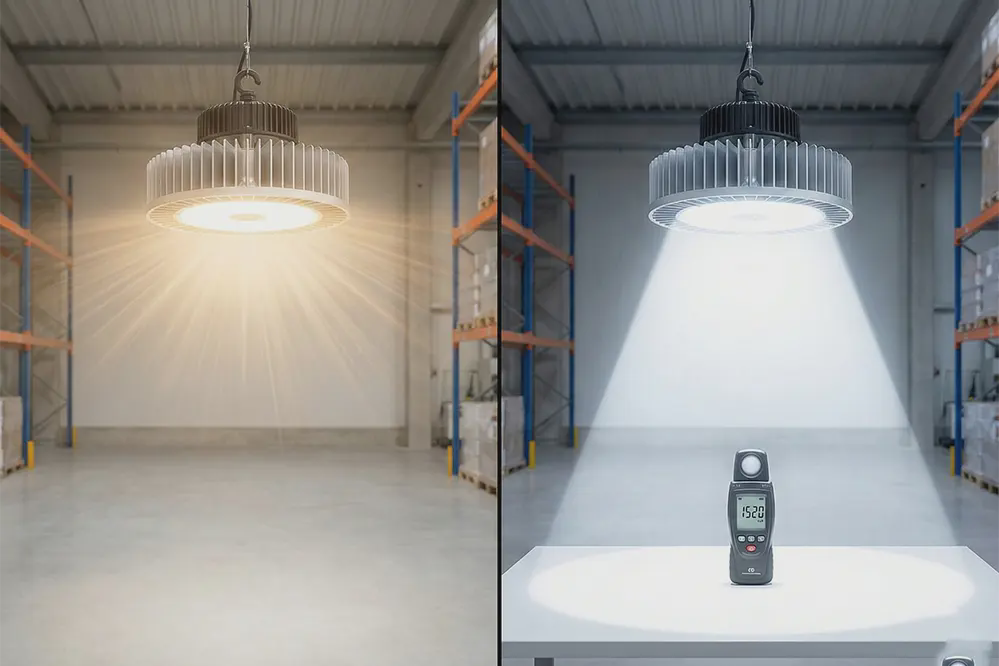
Understanding the distinction between these two measurements prevents costly specification errors.
Lumens: Total Light Output
Lumens measure the total amount of visible light a source emits in all directions. This is a fixed characteristic of the light source itself. A 5,000-lumen LED bulb produces 5,000 lumens whether it's in a closet or a cathedral. The value doesn't change based on the space.
Manufacturers love advertising lumens because higher numbers sound more impressive. They're not wrong to emphasize this metric—lumens matter. But lumens alone don't tell you if the light will be adequate for your application.
Lux: Light Density on Surfaces
Lux measures how much of that light actually reaches and illuminates a specific surface. This value changes constantly based on distance, area, and countless other factors. The same fixture producing consistent lumens will create different lux readings on surfaces at different distances.
This is the metric that determines whether someone can read inspection reports, operate machinery safely, or assemble products without eye strain. Lux is what users experience.
The Area Factor
Here's a concrete example. You install an LED high bay fixture rated at 20,000 lumens in your warehouse. Directly below the fixture at floor level, you might measure 400 lux on a one-square-meter area. Move five meters away horizontally, and that reading drops to 150 lux. The fixture hasn't changed—the area and distance have.
The formula appears simple: Lux = Lumens ÷ Area. But real-world conditions introduce dozens of variables we'll explore later. For now, remember that optimizing lux requires understanding both the light source (lumens) and how that light distributes across your actual workspace (lux).
How to Measure Lux Accurately
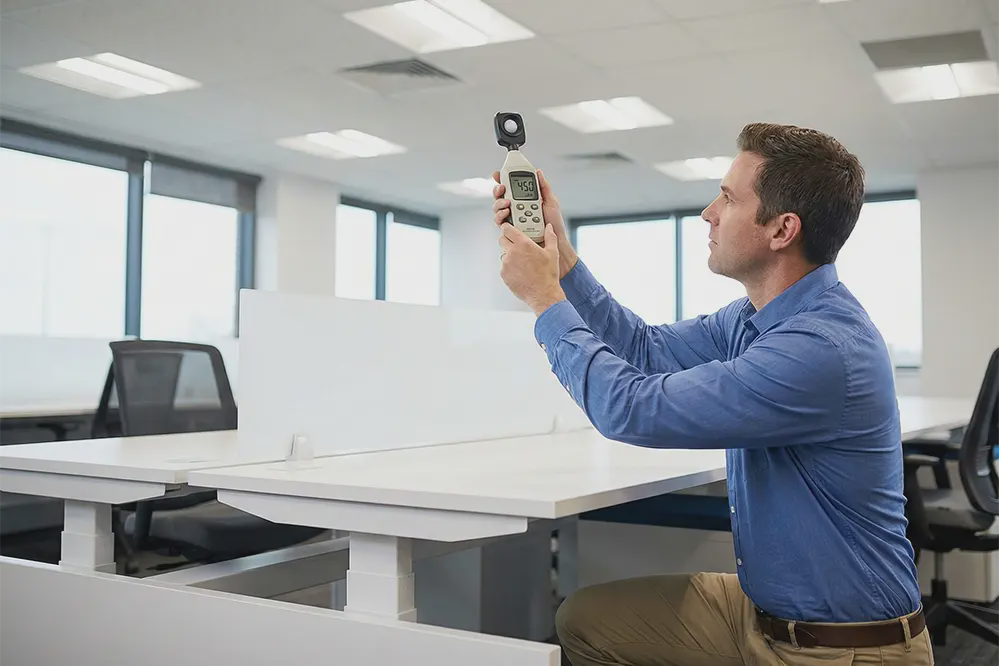
Precision matters when you're specifying hundreds of fixtures for a commercial installation.
Professional Lux Meters
Digital lux meters are the industry standard for commercial applications. These handheld devices use calibrated photodiodes to measure illuminance. Quality meters from manufacturers like Extech, Dr.Meter, or REED Instruments typically cost $50-$300.
Professional-grade meters need annual calibration to maintain accuracy. The certification ensures compliance with lighting standards and regulations. If you're documenting lux levels for OSHA compliance or building inspections, calibrated equipment is mandatory.
Measurement Procedure
Position your lighting system exactly as it will operate. No test conditions or temporary setups—measure the real installation. Hold the lux meter sensor at the task surface level. For office desks, that's desk height. For warehouse picking operations, that's the shelf height where workers read labels.
Take readings at multiple points across the space. A single measurement tells you almost nothing about the overall lighting quality. Professional surveys use grid patterns with measurement points every 2-3 meters, depending on the space size. Record all readings, then calculate the average, minimum, and maximum values.
The minimum value matters most for compliance. If your dimmest corner falls below required lux levels, you fail inspection regardless of how bright the rest of the space is. Document your conditions: note the time of day, whether windows contribute daylight, and any obstructions.
Smartphone Apps vs Professional Tools
Free lux meter apps exist for iOS and Android. They use the phone's ambient light sensor to estimate illuminance. These apps work fine for rough estimates and quick checks. I've used them for preliminary surveys.
But understand their limitations. Phone sensors aren't calibrated for precise measurement. They can be off by 30-50% compared to professional meters. The readings vary based on how you hold the phone, case interference, and screen brightness. Most apps tend to read optimistically high.
For specification work, compliance documentation, or any measurement that affects purchasing decisions, skip the apps. Buy a real meter. The $100 investment pays for itself the first time it prevents a $10,000 lighting mistake.
Recommended Lux Levels for Commercial Applications
Different work environments require specific lux levels based on task requirements and safety regulations.
Office and Administrative Spaces
General office areas need 300-500 lux at desk level. This supports computer work, reading documents, and writing. Conference rooms should hit 500-750 lux since presentations and detailed discussions require better visibility. Reception areas can operate at 200-300 lux—enough for navigation and initial impressions without the intensity of work zones.
I've seen companies try to save money by lighting offices at 200 lux. Within months, they're dealing with complaints about eye strain, reduced productivity, and requests for desk lamps. Hit the 300-500 range from the start.
Industrial Facilities
Warehouse general areas need 150-200 lux for safe navigation between aisles. But this is just for walking paths. Once workers start handling products, requirements jump. Assembly work requires 500-750 lux so workers can see parts clearly. Detailed mechanical work needs 750-1,500 lux for precision tasks. Inspection stations where workers check for defects can require 1,500-2,000 lux or higher.
The variation within a single facility surprises people. Your warehouse might need five different lux levels depending on the zone. Map out task requirements before specifying fixtures.
Healthcare Environments
Corridors and waiting areas operate safely at 100-150 lux. Nursing stations need 300-500 lux for reading charts and preparing medications. Examination rooms require 500-1,000 lux so physicians can perform thorough assessments. Surgical areas demand 10,000-20,000 lux focused on the operating field—some of the highest lux levels in any commercial application.
Healthcare facilities can't compromise on lighting. Inadequate lux levels directly impact patient safety and care quality.
Retail and Hospitality
General retail spaces perform well at 500-750 lux. This level makes products visible without creating harsh glare. Display areas benefit from 750-1,000 lux to highlight merchandise and create visual interest. Restaurants need different levels by zone: dining areas work best at 200-300 lux for ambiance, while kitchens require 500+ lux for food prep safety.
Educational Facilities
Classrooms need 300-500 lux for reading, writing, and viewing instructional materials. Laboratories require 500-750 lux since students perform detailed work and observations. Library reading areas should maintain 500 lux to prevent eye strain during extended reading sessions.
Lux vs Lumens vs Foot-Candles: Understanding All Three
Multiple measurement systems coexist in the lighting industry.
Lux (Metric Standard)
Lux is the international standard under the SI system. Most of the world uses lux for specifications, building codes, and regulations. When you read European lighting standards or international guidelines, values appear in lux.
Foot-Candles (Imperial Measurement)
Foot-candles remain common in the United States, particularly in OSHA regulations and older building codes. One foot-candle equals the illuminance produced by one candle at one foot distance. It's the imperial equivalent of lux.
American contractors and facility managers need to work comfortably with both systems since you'll encounter specifications in foot-candles and product data in lux.
Conversion Formulas
The conversion is straightforward: 1 foot-candle equals 10.764 lux. In reverse, 1 lux equals 0.0929 foot-candles. For quick mental math, remember that 100 foot-candles approximately equals 1,000 lux. Close enough for rough estimates.
OSHA requires 5 foot-candles (54 lux) for warehouses and 30 foot-candles (323 lux) for general work areas. Understanding the conversion prevents confusion when comparing requirements to product specifications.
Candela (Bonus Metric)
Candela measures luminous intensity in a specific direction. Think of it as how "concentrated" the light is along a particular beam path. Candela relates mathematically to both lumens (total output) and lux (illuminance on a surface), but it serves specialized applications like spotlight specification. For general commercial lighting, focus on lumens and lux.
Calculating Lux for LED Lighting Projects
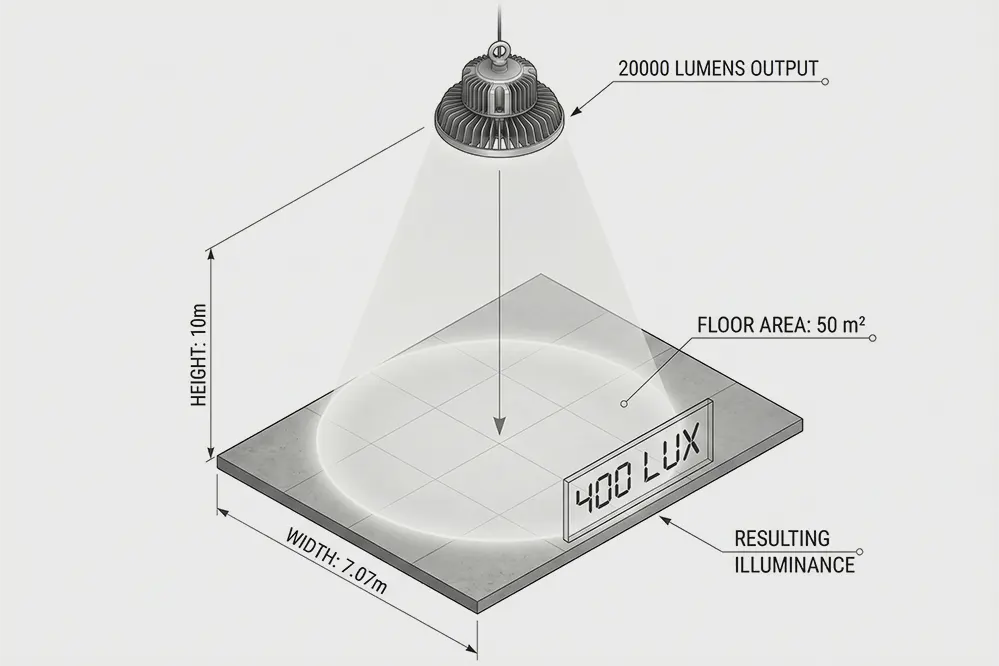
Real-world lux calculation requires more than simple division.
Basic Lux Formula
Start with the foundation: Lux = Lumens ÷ Area (m²). If you have a fixture producing 10,000 lumens and you want to illuminate 50 square meters, the average lux would theoretically be 200 (10,000 ÷ 50 = 200).
But that's just theory. This formula assumes perfect conditions: all light reaches the surface, nothing blocks it, surfaces reflect normally, and the light distributes evenly. Real installations face different physics.
Real-World Factors That Reduce Lux
Distance follows the inverse square law. Double the distance between light source and surface, and lux drops to one-quarter of the original value. A fixture producing 1,000 lux at 2 meters gives you only 250 lux at 4 meters. Height kills lux readings faster than any other factor.
Beam angle determines how light spreads. A narrow 30-degree beam concentrates light into a small area, creating high lux in that spot but darkness elsewhere. A wide 120-degree beam spreads the same lumens across a much larger area, reducing lux but improving uniformity. Neither is wrong—they serve different purposes.
Coefficient of Utilization (CU) accounts for room geometry and surface reflectance. In a room with white ceilings and walls, surfaces reflect light back into the space, effectively increasing lux. Dark surfaces absorb light, reducing lux. CU values range from 0.3 to 0.7 for typical spaces. Your 10,000-lumen calculation needs multiplication by CU to get realistic results.
Light Output Ratio (LOR)
Not all lumens escape the fixture. Diffusers, lenses, and reflector designs trap some light inside the housing. LOR expresses what percentage actually emerges. A fixture with 10,000 lumens at the LED chip but an LOR of 0.85 delivers only 8,500 lumens into the space.
Quality LED fixtures achieve LOR values of 0.85-0.95. Cheaper fixtures with poorly designed optics might fall to 0.70-0.75. That 20% difference directly impacts your lux calculations.
Lumen Depreciation Over Time
LEDs don't burn out like incandescent bulbs—they dim gradually. The industry uses L70, L80, and L90 ratings to describe this. L70 means the point at which the LED outputs 70% of original lumens. For a fixture rated at 50,000 hours L70, you can expect 70% output at 50,000 hours of operation.
This matters for lux planning. If you design a space to achieve exactly 500 lux when fixtures are new, you'll fall to 350 lux after 50,000 hours. Professional designers plan for depreciation by targeting 20-30% higher than minimum requirements initially. The space maintains adequate lux throughout the fixture's life.
Common Lux Measurement Mistakes in Commercial LED Projects
Learn from others' expensive errors.
Mistake 1: Relying Solely on Lumens
A warehouse operator once told me he installed fixtures totaling 500,000 lumens across his facility. He assumed that much light would be more than adequate. He never calculated lux. The 10-meter ceiling height and wide spacing meant most areas received only 75 lux—less than half the recommended minimum. He ended up adding 40% more fixtures.
Always convert lumens to expected lux before purchasing. The conversion takes five minutes and prevents five-figure mistakes.
Mistake 2: Ignoring Distance and Beam Spread
Mounting height dramatically affects lux. A fixture producing 500 lux at 3 meters might deliver only 125 lux at 6 meters. Companies routinely specify fixtures based on data sheets showing lux at standard test distances without considering their actual mounting heights.
Similarly, beam angle changes everything. That narrow spot beam gives you 800 lux directly below but 100 lux two meters away. Wide flood beams provide uniformity but lower peak values. Match beam pattern to application.
Mistake 3: Not Accounting for Obstructions
I measured an "adequately lit" warehouse once—in the empty building before installation. After they installed 5-meter-high shelving, lux readings dropped 40% in aisles. The shelves blocked light from reaching lower levels. Always measure or calculate lux as the space will actually operate, with all equipment in place.
Mistake 4: Measuring at Wrong Heights
Building codes and regulations specify measurement planes. For offices, it's typically desk height (0.75-0.8 meters). For warehouses, it might be floor level for navigation or shelf height for picking operations. I've seen contractors measure lux at ceiling level and declare compliance. The numbers look great until someone points out nobody works at the ceiling.
Verify the required measurement plane for your application. Document which height you measured at.
Mistake 5: Single-Point Measurements
Taking one lux reading in the center of a room tells you almost nothing. Lighting rarely distributes evenly. The center might hit 600 lux while corners struggle to reach 200 lux. Professional surveys use grid patterns with systematic measurement points. For a 1,000-square-meter warehouse, I'd take 50-100 readings minimum.
Mistake 6: Failing to Account for Depreciation
Designing to exactly meet minimum requirements guarantees failure as fixtures age. After 30,000 hours, your LED strips might output 80% of original lumens. That 500 lux you carefully designed for drops to 400 lux. Always design with a depreciation factor of 0.8-0.9, meaning you plan for 556-625 lux initially to ensure you maintain 500 lux long-term.
Factors That Affect Lux Readings on Surfaces
Multiple variables influence final lux values.
Distance from Light Source
The inverse square law governs light behavior. At 1 meter, you measure 1,000 lux. At 2 meters, lux drops to 250 (not 500—it quarters, not halves). At 4 meters, you're down to 62.5 lux. Distance is your enemy in high-ceiling applications. Every additional meter of mounting height costs you lux.
Beam Angle and Light Distribution
LED fixtures offer beam angles from narrow 15-degree spots to wide 120-degree floods. A 10,000-lumen fixture with a 30-degree beam creates intense lux in a small circle. The same lumens in a 90-degree beam spread across nine times the area, reducing lux proportionally. Neither is inherently better—task requirements determine optimal beam angle.
Surface Color and Reflectance
A white ceiling reflects 70-90% of light hitting it. That reflected light bounces back into the space, increasing effective lux. Dark gray surfaces absorb 80-90% of light, contributing almost nothing to room illumination. The ceiling color alone can change lux readings by 20-30%.
Industry-standard reflectance values: white paint (0.80), light gray (0.50), medium colors (0.30), dark surfaces (0.10). Use these coefficients in lux calculations.
Room Geometry
Small rooms with light-colored walls benefit from inter-reflection. Light bounces between surfaces multiple times before being absorbed. Large open spaces lose more light—much of it travels into emptiness before hitting anything. A 5×5-meter office needs fewer lumens per square meter than a 50×50-meter warehouse to achieve the same lux.
Obstructions and Shadows
Shelving units, machinery, hanging equipment—everything casts shadows and blocks direct light paths. In warehouses with tall racking, aisles can receive 50% less light than open areas. Account for obstructions during planning, not after installation.
Ambient Light Contribution
Windows can contribute 1,000-10,000 lux during daytime, depending on orientation and weather. This free light reduces your artificial lighting needs—or creates challenges for lighting control systems trying to maintain consistent lux levels. If your space has significant daylighting, plan for it or control it with sensors that dim fixtures when ambient light is sufficient.
How to Select LED Products Based on Lux Requirements
Smart specification prevents over-spending and under-lighting.
Reading Product Datasheets
Quality manufacturers publish photometric data showing lux values at specified distances. Look for tables or graphs that show lux at 1 meter, 2 meters, 3 meters, and so on. These are measured values, not calculations. Cross-reference beam angle data—narrow beams show high lux at center but poor uniformity.
Be skeptical of datasheets showing only lumens. If a manufacturer won't publish lux data, they're either hiding poor performance or they don't understand professional lighting.
Matching Requirements to Your Space
Start with your required lux level based on application. Office work? 300-500 lux. Calculate room dimensions and mounting height. Now work backward: how many lumens do you need, accounting for CU, LOR, and depreciation? This gives you a target lumen output per fixture.
Then determine fixture count based on spacing. Divide total lumens needed by fixture lumen output. This gives you a minimum fixture count. Add 10-20% for corner coverage and irregularities.
Room Dimensions and Layout
Measure accurately. A 20×30-meter space with 6-meter ceilings requires completely different planning than the same floor area with 4-meter ceilings. Map obstructions. Note areas requiring higher lux levels (inspection zones) versus standard illumination (circulation areas).
Calculate surface reflectance values or use industry standards. White ceiling, light walls, medium floor? Use CU of 0.60. Dark everything? Use CU of 0.40.
Testing Before Full Installation
For projects involving dozens or hundreds of fixtures, install a few units in a representative area. Measure actual lux values. Verify your calculations match reality. Adjust fixture count, height, or spacing before ordering the full quantity. This trial run costs a few thousand dollars and prevents hundred-thousand-dollar mistakes.
Working with Lighting Designers
Complex projects benefit from professional design. Lighting designers use software like DIALux or Relux to simulate lux levels across your entire space. They account for geometry, reflectance, obstructions, and maintenance factors. The simulation produces photometric reports showing predicted lux at any point.
For projects over 10,000 square feet or with critical lighting requirements, professional design pays for itself through optimized fixture selection and placement.
Industry Standards and Safety Regulations for Lux Levels
Compliance isn't optional for commercial facilities.
OSHA Requirements (United States)
The Occupational Safety and Health Administration sets minimum illumination levels for workplace safety. General work areas require 30 foot-candles (323 lux). First aid stations need the same. Warehouses can operate at 5 foot-candles (54 lux) for general areas, though tasks like reading labels require more.
These are minimums, not targets. Design above OSHA minimums for better working conditions and productivity. Meeting exactly 54 lux means any lamp failure or depreciation puts you out of compliance.
IES Recommendations
The Illuminating Engineering Society publishes detailed recommendations that exceed OSHA minimums. IES recognizes that legal minimum and optimal lighting differ significantly. Their standards consider task difficulty, worker age, and accuracy requirements.
IES recommendations typically run 2-3 times higher than OSHA minimums. Following IES guidelines produces better working environments even though they're not legally required.
International Standards
European standard EN 12464 specifies workplace lighting requirements across industries. ISO standards provide international frameworks. If you operate globally or follow international best practices, these standards matter.
Compliance Documentation
Maintain measurement records showing your facility meets requirements. Document meter calibration dates, measurement locations, readings, and dates. Inspectors can request proof of compliance. Many insurance policies require adequate lighting, and claims can be denied if you can't demonstrate proper illumination.
Real-World Lux Examples and Context
Understanding lux values helps develop intuition for what different levels mean.
Natural Light Conditions
Direct sunlight delivers 100,000-130,000 lux at ground level on clear days. This is why windows provide such excellent illumination. An overcast day still gives you around 1,000 lux outdoors—more than most indoor artificial lighting. Even a full moon provides 0.5-1 lux, enough to see shapes and navigate, though far below what we consider adequate for any work.
Common Indoor Scenarios
TV studios light sets to roughly 1,000 lux for broadcast-quality video. A well-lit office hits 500-700 lux at desk level. Typical living rooms operate at 300-400 lux—comfortable for relaxation but insufficient for detailed work. Parking garages often run 50-100 lux, enough to navigate safely and locate vehicles but dim compared to outdoor daylight.
Putting Numbers in Perspective
The difference between 100 lux and 500 lux is immediately noticeable. At 100 lux, you can navigate and see large objects clearly, but reading small text strains your eyes. At 500 lux, reading is comfortable and detailed work is possible. Jump to 5,000 lux, and you're approaching outdoor lighting levels—bright enough that most people find it excessive for indoor spaces unless performing surgical-precision work.
FAQ
Does higher lumens always mean higher lux? No. Lumens measure total output; lux measures what reaches a surface. A 10,000-lumen fixture in a large space creates lower lux than a 5,000-lumen fixture focused on a small area. Distance and beam spread matter more than raw lumen output.
What is 1000 lux equivalent to in real-world terms? About the illumination in a well-lit office or TV studio. It's bright enough for detailed work, comfortable for extended periods, but well below outdoor daylight levels.
Is lux the same as brightness perception? Not exactly. Lux measures physical illuminance. Brightness perception involves psychology, adaptation, and context. A room at 300 lux feels bright after being in darkness but dim after coming from sunlight.
How many lux do I need for a warehouse? General navigation requires 150-200 lux. Product handling needs 300-500 lux. Detailed inspection work requires 750-1,500 lux. Map your warehouse by task and apply appropriate levels to each zone.
Can you convert lumens to lux without knowing the area? No. Lux = Lumens ÷ Area. Without knowing area (and distance, and beam angle), you cannot calculate lux. This is why lumen-only specifications fail—they omit critical variables.
What is the lux level of direct sunlight? 100,000-130,000 lux on a clear day. This is 200-300 times brighter than typical office lighting and explains why natural daylight feels so much better than artificial light.
Why does my lux meter show different readings in different spots? Light rarely distributes evenly. Areas directly under fixtures receive more illumination. Corners and spaces between fixtures receive less. Surface angles and obstructions create variations. This is normal and why you need multiple measurements.
Are lux levels regulated by OSHA or safety standards? Yes. OSHA sets minimum foot-candle requirements for different work types. IES publishes recommended levels. Many industries have specific standards. Check regulations applicable to your facility type.
How do I calculate lux for my specific space? Lux = (Lumens × CU × LOR) ÷ Area. Account for mounting height using inverse square law. Factor in depreciation. Use published tables or lighting software for precision. Or hire a lighting designer for complex projects.
What's the difference between lux and foot-candles? Different units measuring the same thing. Lux is metric (lumens per square meter). Foot-candles are imperial (lumens per square foot). 1 foot-candle = 10.764 lux. Both measure illuminance on a surface.
Conclusion
Lux measurements reveal what lumens alone cannot: actual lighting performance at the surfaces where people work. A fixture advertising 20,000 lumens tells you nothing about whether employees can read inspection reports, assemble components accurately, or navigate safely. Lux tells you everything.
The most expensive lighting mistakes come from ignoring lux in favor of impressive lumen numbers. I've watched companies spend hundreds of thousands on inadequate installations because they specified based on lumens and hoped for the best. Measure lux at task surfaces. Account for mounting height, beam angle, and real-world depreciation. Design for maintained illuminance, not initial performance.
Professional tip: target 20-30% above minimum requirements when fixtures are new. After 50,000 hours and some lamp failures, you'll still meet minimums. Under-designing saves money upfront but costs far more in productivity losses, safety incidents, and eventual retrofitting.
Proper lux measurement prevents costly under-lit facilities and stops energy waste on over-lighting. Master this measurement, and you'll never make another expensive lighting mistake.