
Types of LED lighting: Understanding DIP, SMD, and COB LEDs
- 2024-03-28 15:29
- UNITOP
Since Nick Holonyak invented the first practical DIP LED in 1962, the lighting industry has evolved through three major package technologies. Today, choosing between DIP (Dual In-line Package), SMD (Surface Mount Device), and COB (Chip on Board) LEDs directly impacts project performance and costs.
LED package type refers to how semiconductor chips are mounted, encapsulated, and electrically connected to circuit boards, fundamentally determining luminous efficacy, thermal performance, pixel density, and commercial application suitability. While residential buyers focus on aesthetics, commercial projects require evaluation of performance specifications, maintenance requirements, and total cost of ownership.
Understanding LED technology basics provides the foundation, but selecting the right package type for your specific application determines project success.
What Are LED Package Types?
LED package type describes the physical and electrical configuration used to mount semiconductor chips and extract light. The package encompasses chip mounting method, thermal management, optical characteristics, and electrical connections.
Package technology evolved through three generations: DIP LEDs emerged in 1962 with through-hole mounting for robust connections. SMD arrived in the 1980s, enabling automated assembly and RGB color mixing. COB developed in the 2010s, packing multiple chips directly onto substrates for maximum density.
Each generation solved specific problems: DIP addressed outdoor brightness and durability, SMD enabled versatile color control and higher resolution, COB delivered seamless appearance for premium applications. Luminous efficacy ranges from 35-80 lm/W for DIP to 50-100 lm/W for SMD to 80-100+ lm/W for COB.
DIP LEDs: Through-Hole Package Technology
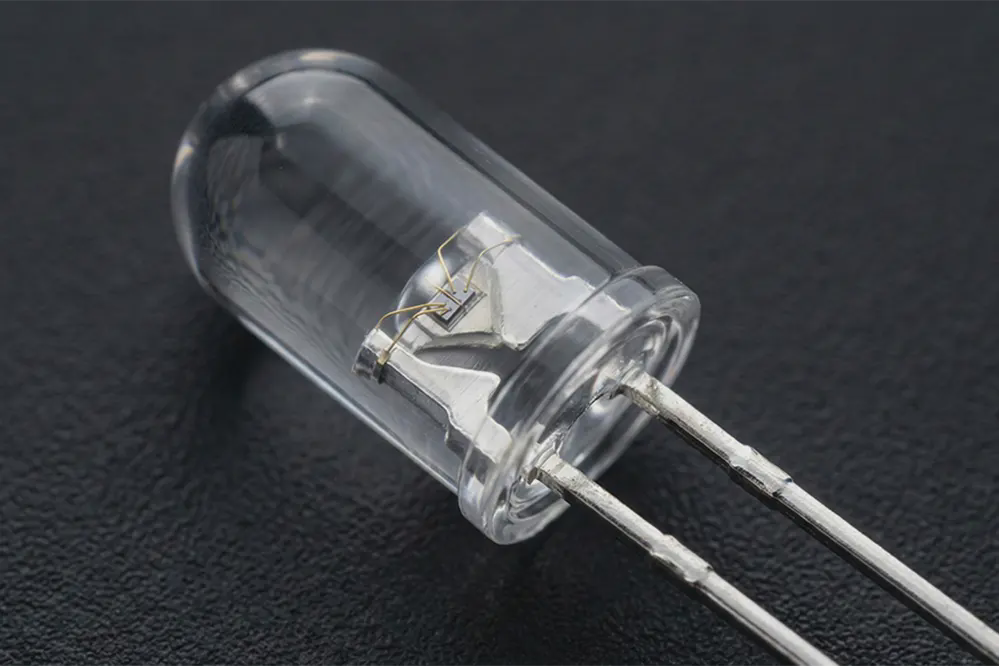
DIP LED (Dual In-line Package) uses through-hole mounting where two parallel leads extend from an epoxy-encased chip and insert through holes in the PCB. The familiar bullet-shaped design—typically 3-5mm diameter—has defined LED appearance for five decades.
A semiconductor chip sits in a reflector cup, wire-bonded to metal leads, then encapsulated in epoxy resin. This epoxy provides mechanical protection, acts as a primary lens, and seals against moisture. The long leads provide electrical connection and heat dissipation, though thermal resistance remains higher than modern packages.
Technical Specifications:
Output: 3-4 lumens per device
Efficacy: 35-80 lumens per watt
Drive current: 20-30mA at 5-24V (12V typical)
Power: 0.05-0.08 watts per device
Beam angles: 15°-120° depending on lens
Viewing angle: 70-110° (narrower than SMD/COB)
Brightness: 7,500-10,000 nits for outdoor applications
Advantages: Through-hole construction provides exceptional mechanical strength—soldered leads withstand vibration better than surface-mount alternatives. DIP delivers highest brightness for outdoor conditions with IP65 waterproof protection. Power consumption runs approximately one-third of SMD in outdoor applications, with lifespans reaching 100,000 hours.
Limitations: Size restricts DIP to pixel pitches of P6 or larger. Large pitch means longer viewing distances and lower resolution. Single-chip design prevents RGB color mixing, and narrower viewing angles limit coverage.
Commercial Applications: Outdoor LED displays (P10+), traffic signals, large-format advertising, industrial indicators where brightness and durability outweigh resolution concerns.
SMD LEDs: Surface Mount Device Technology
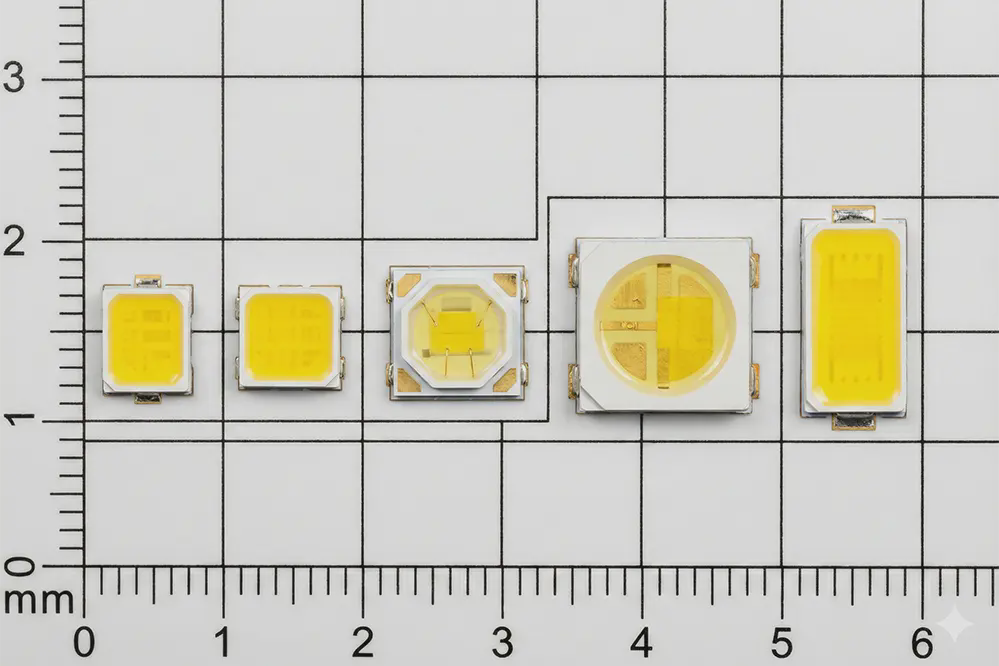
SMD LED (Surface Mounted Device) chips mount directly onto PCB surfaces through automated placement and reflow soldering. Unlike DIP's through-holes approach, SMD uses flat contact pads, enabling smaller packages and higher density.
The key innovation: integrating three diodes (red, green, blue) into a single chip enables full-color control. SMD chips range from 2-6 contacts depending on diode count—a three-diode RGB chip has six contacts (two per color).
Common SMD Chip Sizes:
2835 (2.8×3.5mm): Most efficient, 20% more light than 5050, ideal for commercial lighting
3030 (3.0×3.0mm): Wide angle, highest flux, used in Unitop's outdoor products and high bays
3535 (3.5×3.5mm): Ceramic high-power for demanding outdoor applications
5050 (5.0×5.0mm): Three-diode RGB for color mixing, popular in 60 LED/meter strips
5630 (5.6×3.0mm): High brightness for commercial and signage applications
Technical Specifications:
Output: 4-5 lumens per diode
Efficacy: 50-100 lumens per watt
Voltage: 12V or 24V (12V typical)
Power: 0.05-0.24W depending on configuration
Viewing angles: 160°+
Energy efficiency: 75% reduction versus DIP
Thermal management improves over DIP because chips contact PCB directly, using copper traces as heat sinks. This extends operational life to 50,000-100,000 hours with proper design.
Advantages: Automated surface-mount manufacturing reduces costs despite higher complexity. RGB integration enables sophisticated color control impossible with DIP. Compact size suits versatile applications from LED strip lights to street lighting. SMD has become mainstream for balancing performance, versatility, and economics.
Limitations: More susceptible to soldering defects than through-hole DIP. Quality thermal management remains critical—inadequate heat sinking degrades output and shortens lifespan.
Applications: LED strip lights (Unitop specialty), indoor video walls, architectural accent lighting, commercial illumination, signage, street lighting, floodlights, high bay fixtures.
COB LEDs: Chip-on-Board Technology
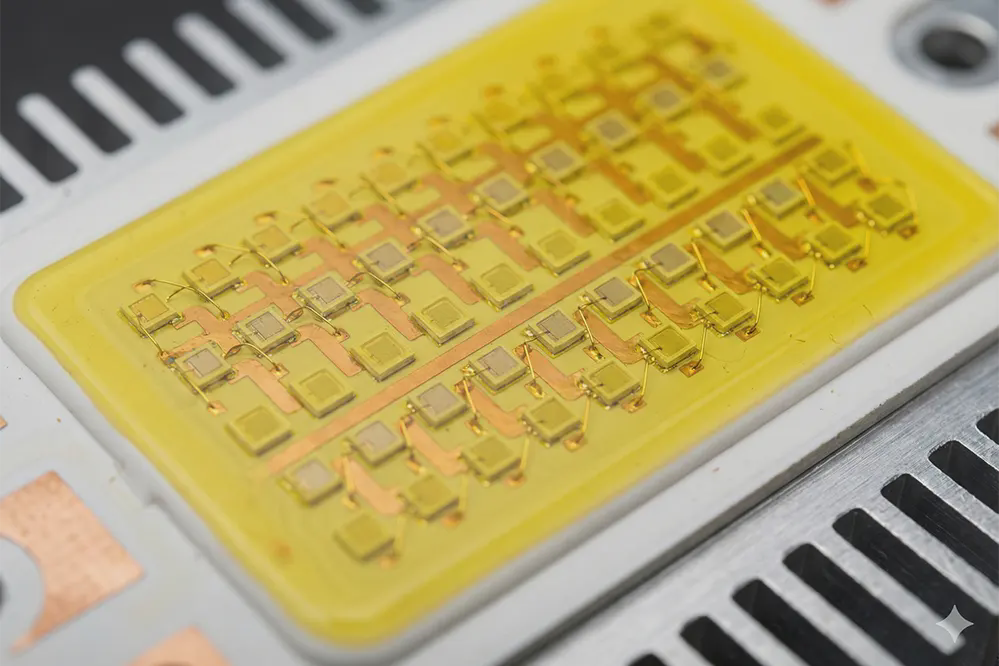
COB LED (Chip on Board) mounts multiple LED chips—typically nine or more—directly onto a substrate to form a single high-density module. Rather than packaging chips individually, COB bonds bare chips directly to ceramic, aluminum, or silicon carbide substrates.
This approach achieves remarkable density: COB packs 38 times more LEDs than DIP and 8.5 times more than SMD into equivalent areas. This enables ultra-fine pixel pitches below 1.6mm, reaching P0.9 for 4K and 8K displays.
Technical Specifications:
Configuration: 9+ diodes per module
Circuit design: Single circuit + 2 contacts (simplified vs SMD)
Efficacy: 80-100+ lumens per watt
Viewing angles: 175-180° (widest available)
Pixel pitch: <1.6mm capable (down to P0.9)
Advantages: Highest luminous efficacy among package types. Seamless uniform light with no visible pixel separation. Superior thermal management through direct substrate contact. Fully encapsulated design protects against oxidation.
Limitations: Higher production costs due to complex manufacturing. Color consistency challenges require factory calibration. Lower production yields than mature SMD processes. Cannot create color-changing effects without multiple channels. Requires larger heat sinks despite excellent thermal transfer.
Commercial Applications: High-end indoor displays, broadcast studios, control rooms, architectural lighting, automotive headlights, professional photography/studio lighting, premium downlights and track lighting, luxury retail displays.
Emerging LED Package Variants
Package technology continues evolving beyond DIP-SMD-COB:
GOB (Glue-On-Board): Applies transparent epoxy over SMD modules, enhancing durability and environmental protection. Improves bump resistance and moisture protection for fine-pitch displays and rental screens.
MCOB (Multiple Chip On Board): Multiple COB chips in series, optimized for low-wattage applications like A19 bulbs.
MIP (Micro LED Package): Ultra-high resolution with fine pixel pitches and exceptional image quality.
IMD (Integrated Matrix Device): Improves dimensional accuracy and color consistency over standard COB.
These variants represent specialized solutions for specific market segments. Most commercial projects still specify DIP, SMD, or COB based on proven performance.
Direct Comparison: DIP vs SMD vs COB
Size & Brightness:
DIP: Largest (3-5mm), 3-4 lumens, 7,500-10,000 nits outdoor
SMD: Medium (1.4-5.6mm), 4-5 lumens, 500-2,000 nits
COB: Compact module, high-intensity concentrated output
Efficacy & Power:
DIP: 35-80 lm/W, 0.05-0.08W per device
SMD: 50-100 lm/W, 0.05-0.24W per chip
COB: 80-100+ lm/W (highest efficiency)
Resolution & Viewing:
DIP: P6 minimum (typically P10+), 70-110° viewing angle
SMD: P1.2-P10 range, 160°+ viewing angle
COB: P0.9 and finer capable, 175-180° viewing angle
Color Capability:
DIP: Single color only
SMD: Full RGB integration (3-diode chips)
COB: Highest CRI, limited color-changing
Durability & Cost:
DIP: Best mechanical strength, lowest component cost, IP65 typical
SMD: Good reliability, medium cost, IP20-IP67 range
COB: Excellent protection, highest cost, requires calibration
Lifespan: All three achieve 50,000-100,000 hours with proper thermal management.
Choosing the Right LED Package Type for Your Application
Selecting the optimal LED package requires matching technology capabilities to specific project requirements. No single package type wins every application—the optimal choice depends on environmental conditions, performance needs, budget constraints, and installation context.
Application Guidelines:
Outdoor High-Brightness Applications: DIP technology still dominates large-format outdoor displays, highway billboards, and traffic signals where brightness exceeds 7,500 nits and viewing distances stretch beyond 15 meters. The mechanical robustness, IP65 weather resistance, and lower power consumption (one-third of SMD in outdoor contexts) deliver better total cost of ownership despite lower resolution. If your project involves direct sunlight visibility, extreme temperature cycling, or long viewing distances where P10 pixel pitch suffices, DIP remains the practical choice.
Indoor Commercial and Architectural Lighting: SMD packages win most indoor commercial projects through versatility, proven reliability, and competitive pricing. The 2835 and 3030 chips handle general commercial lighting—offices, retail, warehouses—while 5050 RGB variants enable dynamic architectural effects. Unitop's LED strip lights leverage SMD technology specifically because the package size, mounting flexibility, and color control align with commercial architectural requirements. For projects requiring specific color temperatures between 2700K and 6500K, RGB color-changing capability, or pixel pitches from P2 to P6, SMD delivers optimal performance-to-cost ratios.
Premium Indoor Displays and Specialty Applications: COB justifies its premium pricing in high-end installations where seamless appearance, ultra-fine resolution, or superior color rendering drive specifications. Broadcast studios require P1.6 or finer pitch with exceptional color accuracy—COB delivers. Luxury retail displays benefit from seamless, uniform light quality. Automotive headlights need concentrated output from compact packages. Professional photography studios demand high CRI and color consistency.
Resolution and Viewing Distance Requirements: Pixel pitch determines viewing distance. A simple formula: minimum comfortable viewing distance (meters) = pixel pitch (mm) ÷ 1.0.
Close viewing (<3 meters): COB provides ultra-fine pitch and seamless appearance. Conference rooms, control centers, and luxury retail demand this quality level.
Medium viewing (3-10 meters): SMD handles most applications efficiently. Shopping malls, corporate lobbies, auditoriums, and most commercial signage fall here.
Long viewing (>10 meters): DIP remains cost-effective for outdoor advertising, highway information signs, and large venue scoreboards where resolution matters less than brightness.
Budget Considerations: Compare initial investment against operational costs and expected service life. DIP components cost least but require manual assembly labor. SMD offers the best balance—moderate component cost with automated assembly. COB starts 30-50% higher but potentially saves energy over decades.
Calculate total cost of ownership including energy consumption (watts × operating hours × electricity rate), maintenance frequency (mean time between failures × service call costs), and replacement intervals. A higher-efficacy SMD or COB installation often pays back initial premiums within 3-5 years through reduced electricity bills and lower maintenance frequency.
Brightness and Lumen Requirements: Different applications demand vastly different output levels. Outdoor direct sunlight requires 7,500-10,000 nits—DIP territory. Indoor commercial spaces need 500-2,000 nits—SMD handles easily. Precise task lighting or dramatic accent lighting leverages COB's concentrated output.
Brightness without proper color rendering delivers poor results. A 90+ CRI rating matters for retail product displays, hospitality spaces, and any application where color accuracy affects perceptions.
Installation and Future Maintenance: If modular replacement capability matters—rental installations, temporary displays, or locations with limited technical staff—SMD's modular design simplifies service. Individual faulty sections can be swapped quickly without specialized expertise.
Permanent installations with professional maintenance staff can consider COB despite module-level replacement requirements. DIP's through-hole construction allows individual LED replacement but demands skilled technicians.
LED Package Types in Commercial Lighting Products
LED Strip Lights: SMD packages dominate strip lighting because flexibility, RGB control, and form factor requirements align perfectly with surface-mount technology. The 2835 chip provides optimal efficacy for architectural cove lighting, under-cabinet installations, and linear accent applications. The 5050 RGB variant enables dynamic color-changing effects in hospitality, entertainment, and retail environments.
Unitop's strip light products leverage 2835 and 3030 SMD packages because these deliver the brightness uniformity, color temperature consistency, and reliability that commercial projects demand. The automated SMD manufacturing process ensures tight binning tolerances—critical when installers specify 3000K warm white across hundreds of meters. Inconsistent color temperatures from loose binning destroy visual continuity in commercial spaces.
LED Displays and Video Walls: SMD serves as the workhorse for most commercial display installations from P1.2 to P10 pixel pitches. Indoor video walls, shopping mall displays, corporate lobby screens, and transportation information systems rely on SMD's balance of resolution, brightness, and manufacturing maturity.
COB enters when specifications demand ultra-fine pitch below P1.6—broadcast studios, mission-critical control rooms, and luxury installations where seamless appearance justifies premium pricing.
DIP holds the outdoor market above P10 where brightness and weather resistance outweigh resolution requirements. Highway advertising, stadium perimeter boards, and building-mounted signage continue specifying DIP for proven durability.
High-Bay and Industrial Lighting: SMD 3030 and 3535 packages dominate because they balance high output, good thermal management, and competitive pricing for warehouse, manufacturing, and distribution center applications. The ceramic-packaged 3535 variant handles higher drive currents needed for 150-200W high-bay fixtures replacing 400W metal halide systems.
Architectural and Accent Lighting: COB delivers the uniform wash and seamless appearance that architects prefer for wall washing, facade lighting, and museum illumination. The lack of visible pixels creates smooth gradients and shadow-free surfaces.
SMD handles architectural applications requiring RGB color control, dynamic effects, or integration with building management systems. The ability to individually address SMD RGB chips enables sophisticated lighting scenes impossible with single-circuit COB modules.
Outdoor Signage and Area Lighting: SMD 3030 and 3535 ceramic packages displaced DIP in most outdoor commercial lighting over the past decade. Street lights, parking lot fixtures, building floodlights, and perimeter security lighting now predominantly use SMD technology for better efficacy and more precise optical control.
Technical Specifications That Matter
Luminous Efficacy (Lumens Per Watt): This fundamental metric—how many lumens of light output per watt of electrical input—determines operating costs over decades. DIP's 35-80 lm/W served adequately when competing against incandescent and fluorescent alternatives but falls behind SMD's 50-100 lm/W and COB's 80-100+ lm/W in modern installations.
Higher efficacy directly reduces electricity consumption. A 100W SMD fixture producing 10,000 lumens (100 lm/W) delivers equivalent light to a 143W DIP fixture at 70 lm/W. That 43W difference, compounded across hundreds of fixtures running 4,000+ hours annually, generates substantial savings.
Color Temperature and Binning: LED manufacturers specify color temperature in Kelvin, ranging from warm 2700K (incandescent-like) to cool 6500K (daylight). Commercial projects typically specify 3000K (warm white), 4000K (neutral white), or 5000K (cool white) based on application.
The critical specification: binning tolerance. A "3000K" LED might actually measure anywhere from 2870K to 3220K depending on binning standards. Three-step MacAdam ellipse binning ensures tighter tolerances than five-step or seven-step alternatives. Specifying tight binning prevents the color temperature variations that ruin visual continuity when mixing LED batches.
Color Rendering Index (CRI): CRI measures how accurately LEDs render object colors compared to natural light. The 0-100 scale indicates fidelity—CRI 100 matches sunlight perfectly. Most commercial LEDs achieve CRI 80-85, adequate for general lighting. Premium applications specify CRI 90+ for accurate color rendering in retail, hospitality, and healthcare environments.
COB packages typically deliver the highest CRI values due to optimized phosphor formulations and better optical mixing. SMD achieves 80-90 CRI with quality components. Understanding CRI helps specify appropriate packages for color-critical applications.
Thermal Management and Junction Temperature: LED lifetime directly correlates with junction temperature—the semiconductor chip's operating temperature. Every 10°C junction temperature increase roughly halves LED lifespan. Manufacturers rate maximum junction temperatures, typically 85-105°C, but running cooler extends life.
Quality installations ensure junction temperatures stay well below maximums through adequate heat sinking. COB's direct substrate bonding provides excellent thermal paths but concentrated heat density demands substantial aluminum heat sinks. SMD's PCB contact offers good thermal performance with more distributed heat generation.
Lifespan Standards (L70, L80): LED lifespan requires careful definition. Unlike incandescent bulbs that simply burn out, LEDs gradually dim over thousands of hours through lumen depreciation. Industry standards define useful life as the point where output drops to 70% of initial lumens (L70 rating) or 80% (L80 rating).
A 50,000-hour L70 rating means the LED maintains at least 70% output after 50,000 operating hours under specified conditions. Actual lifespan depends heavily on thermal management, drive current, and environmental factors.
IP Ratings and Environmental Protection: The Ingress Protection (IP) code defines protection against solid particles (first digit) and liquids (second digit). IP65 provides dust-tight sealing and protection against water jets—adequate for most outdoor applications. IP67 adds temporary immersion resistance. IP20 indicates basic indoor protection without special sealing.
DIP outdoor packages typically achieve IP65 through epoxy encapsulation and through-hole mounting. SMD ranges from IP20 (basic indoor) to IP67 (outdoor with conformal coating). COB depends on module encapsulation quality but can achieve high ratings when properly sealed.
FAQ
Which LED package type is most energy efficient? COB LEDs typically achieve the highest luminous efficacy at 80-100+ lumens per watt, followed by SMD at 50-100 lm/W and DIP at 35-80 lm/W. However, efficiency depends on specific chip quality, thermal management, and drive conditions. In some outdoor applications, DIP consumes less total power than SMD alternatives despite lower per-LED efficacy.
Can DIP LEDs be used indoors? Yes, though they're rarely optimal. DIP's large size limits resolution, and the narrower viewing angles (70-110°) reduce audience coverage compared to SMD (160°+) or COB (175-180°). SMD delivers better indoor performance at competitive cost. DIP makes sense indoors only for specific indicator or signaling applications where brightness and mechanical robustness justify the trade-offs.
What is the lifespan difference between SMD and COB LEDs? Both SMD and COB packages achieve 50,000-100,000 hour lifespans under proper conditions. The actual difference depends more on thermal management quality, drive current levels, and environmental stress than inherent package design. COB's superior thermal transfer potentially extends life, but only if installations provide adequate heat sinking. Poor thermal design degrades any package type prematurely.
Which LED type is best for LED strip lights? SMD dominates LED strip lighting because the package size, mounting flexibility, and RGB capabilities align perfectly with architectural and commercial requirements. The 2835 chip provides excellent efficacy for single-color applications, while 5050 RGB enables dynamic color control. COB strips exist but cost more and sacrifice the flexibility that makes strips attractive. DIP's size prevents practical strip integration.
Why are COB LEDs more expensive than SMD? COB requires more complex manufacturing: direct chip bonding to substrates, individual wire bonding for dozens of chips, careful epoxy potting, and factory calibration to ensure color consistency. Production yields run lower than mature SMD processes. The benefits—seamless appearance, ultra-fine pitch, highest efficacy—justify premiums for demanding applications but make COB impractical where SMD performs adequately.
Can I replace DIP LEDs with SMD LEDs in existing displays? Rarely practical. DIP uses through-hole mounting while SMD requires surface-mount PCB designs—incompatible manufacturing approaches. Upgrading from DIP to SMD means replacing entire modules or panels, not individual LEDs. The investment typically makes sense only when resolution, color capability, or energy efficiency improvements justify complete system replacement.
What does "pixel pitch" mean for LED packages? Pixel pitch measures the center-to-center distance between adjacent LEDs in millimeters. P10 means 10mm spacing, P2 means 2mm spacing. Smaller pitch enables finer resolution and closer viewing distances. DIP packages can't achieve fine pitch due to physical size—P6 minimum, typically P10+. SMD handles P1.2-P10 range. COB enables ultra-fine P0.9 and finer for 4K/8K applications.
Which LED package type has the best color accuracy? COB typically delivers the highest CRI (Color Rendering Index) ratings—90+ is common—due to optimized phosphor formulations and excellent optical mixing across densely-packed chips. Premium SMD packages achieve CRI 90+ but most commercial SMD rates 80-85. DIP color rendering varies widely; the single-chip design limits optimization compared to multi-chip packages.
How do I choose between SMD chip sizes (2835 vs 3030 vs 5050)? Match chip capabilities to application requirements:
2835: Most efficient option for high-volume commercial lighting, best lumens-per-watt
3030: Highest flux output, handles higher drive currents, ideal for outdoor commercial lighting requiring robust performance
3535: Ceramic high-power package for demanding outdoor applications (stadium lights, large floodlights)
5050: RGB color mixing, architectural effects, slightly lower efficiency than 2835
For Unitop LED strips, 2835 provides optimal efficiency for architectural lighting, while 5050 RGB enables dynamic color-changing effects.
Do COB LEDs require special heat sinks? Yes. COB concentrates multiple chips in small areas, generating significant heat density. The superior thermal path from direct substrate bonding helps, but the concentrated heat load demands substantial aluminum heat sinking. COB modules typically need larger, heavier heat sinks than equivalent SMD installations. Inadequate thermal management quickly degrades COB performance and shortens lifespan.
Conclusion
Choosing between DIP, SMD, and COB LED packages isn't about finding a universal "best" technology—it's matching package capabilities to commercial requirements.
DIP technology, despite 1962 origins, remains optimal for outdoor high-brightness applications where durability, weather resistance, and direct sunlight visibility outweigh resolution. Highway billboards, traffic signals, and large-format advertising leverage DIP's proven extreme-condition performance with 100,000-hour lifespans and lower power consumption (one-third of SMD in outdoor contexts).
SMD packages dominate commercial lighting because they balance versatility, reliability, and economics. RGB integration enables sophisticated color control impossible with single-chip DIP. The range of chip sizes addresses nearly every commercial requirement from LED strip lights to street lighting. Unitop's LED strip products leverage SMD technology because the package characteristics align with architectural and commercial demands: precise color temperature control, RGB capability, and proven reliability.
COB represents the premium tier, justifying 30-50% cost premiums through seamless appearance, ultra-fine resolution, and highest luminous efficacy. Broadcast studios, luxury retail, high-end architectural installations, and applications demanding exceptional color rendering find COB capabilities worth the investment.
Beyond these three mainstream packages, emerging variants like GOB, MCOB, IMD, and MIP address specialized requirements but don't replace the core technologies.
Selection Guidelines:
DIP when: Outdoor applications, direct sunlight required, viewing distance >10m, mechanical durability critical, P10+ pixel pitch acceptable
SMD when: Indoor/outdoor commercial lighting, resolution matters, RGB control desired, cost-effectiveness important, P1.2-P6 pitch needed
COB when: Ultra-fine pitch required (<P1.6), seamless appearance critical, highest color accuracy demanded, close viewing (<2m)
Understanding LED package types provides the foundation for successful commercial lighting projects that meet performance requirements, stay within budgets, and deliver long-term value.