
Unraveling LED Technology: What Is LED & How It Works
- 2024-03-01 18:39
- UNITOP
Walk into any room and you'll spot LEDs everywhere—your smartphone, TV, ceiling lights, car dashboard. They're in traffic signals, stadium displays, and the headlights of passing cars. By 2035, the Department of Energy estimates LED lighting will save 569 terawatt-hours of electricity annually in the United States alone—equivalent to the annual output of 92 large power plants. Yet despite their ubiquity, most people don't understand how these tiny powerhouses actually work or why they've become the dominant lighting technology so quickly.
An LED (Light Emitting Diode) is a semiconductor device that emits light when electric current passes through it, converting 80-90% of energy into light rather than heat. Compare that to traditional incandescent bulbs, which waste 90% of their energy as heat, and you'll understand why LEDs are revolutionizing how we light our homes, businesses, and cities.
Here's what you need to know: the science behind LED technology, how these semiconductors create light, why they outlast traditional bulbs by decades, and what to consider before buying your next LED product.
What is LED?
LED stands for Light Emitting Diode. Breaking it down: it's a diode (an electronic component that allows current to flow in only one direction) that emits light as a byproduct of its operation. Unlike incandescent bulbs that produce light by heating a metal filament until it glows white-hot, or fluorescent tubes that use electrically-excited gas discharge, LEDs generate light directly through a process called electroluminescence in semiconductor materials.
The technology isn't entirely new. General Electric scientist Nick Holonyak Jr. created the first practical visible-spectrum LED in 1962, producing dim red light. For three decades, LEDs could only produce red, yellow, and green colors—useful for indicator lights and displays but inadequate for general illumination. The breakthrough came in 1993 when Japanese electrical engineer Shuji Nakamura, working with physicists Isamu Akasaki and Hiroshi Amano, developed the first high-brightness blue LED. This discovery was so significant it earned all three researchers the 2014 Nobel Prize in Physics. Why? Because blue LEDs made white LED lighting possible—and fundamentally changed the entire lighting industry.
An LED consists of several key components working together. At its heart is a semiconductor chip mounted on a reflector cup. This tiny chip contains the p-n junction where the actual light generation occurs. Two electrical contacts (the anode and cathode) connect to your power source, providing the current needed for operation. The entire assembly sits within an epoxy or plastic encapsulation that protects the delicate internal components and often acts as a lens to focus or diffuse the emitted light.
Today, LEDs are rapidly replacing incandescent and fluorescent lighting in homes, businesses, and cities worldwide. Their superior energy efficiency, extraordinary operational lifespan, decreasing manufacturing costs, and environmental benefits make them the obvious choice for nearly every lighting application imaginable.
How LEDs Work: The Science Behind the Light
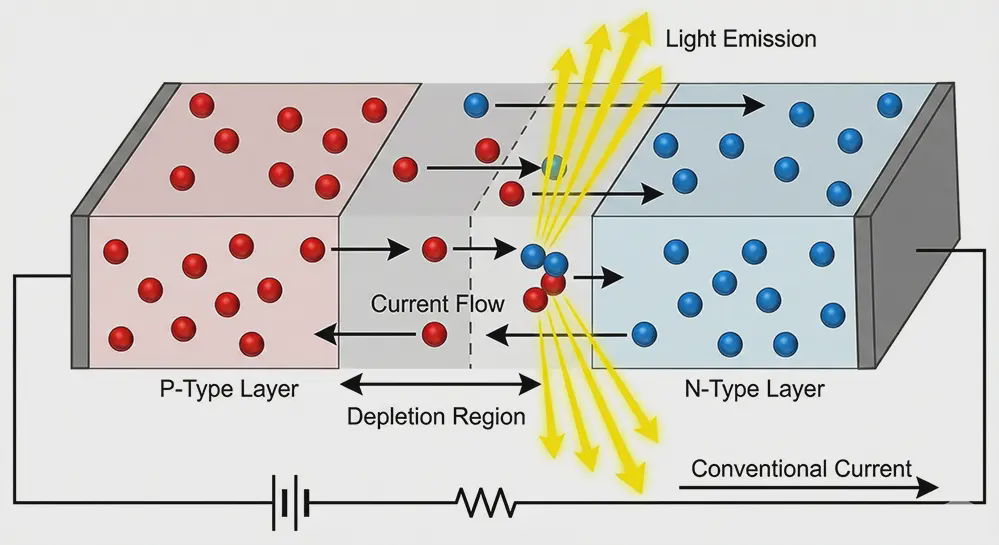
The Semiconductor Foundation
A semiconductor conducts electricity better than an insulator (rubber) but not as well as a conductor (copper wire). Common LED materials include gallium arsenide and indium gallium nitride.
Pure semiconductors conduct poorly. Manufacturers add tiny impurities—called doping—creating two material types:
N-type semiconductors have extra electrons free to move around.
P-type semiconductors have electron deficits creating "holes" that act like positive charges.
When you bond n-type and p-type materials together, you create a p-n junction. Electrons from the n-type side flow across to fill p-type holes, creating a depletion zone that prevents current flow.
Electroluminescence Process
When you apply the correct voltage polarity (positive terminal connected to the p-type side, negative to the n-type side), you create what's called forward bias. This applied voltage overcomes the depletion zone's natural resistance to current flow.
Electrons from the n-type region get pushed toward the junction. Simultaneously, holes from the p-type region move in the opposite direction. When electrons and holes meet at the junction, they recombine—an electron essentially falls into a hole, dropping from a higher energy state (the conduction band) to a lower energy state (the valence band).
That energy difference has to go somewhere—it can't just disappear. In LEDs made from appropriate semiconductor materials, this energy releases as a photon—a particle of light. This process is called electroluminescence, and it's fundamentally different from how incandescent bulbs work (resistive heating of a wire filament) or how fluorescent tubes operate (exciting gas atoms to produce UV light that hits phosphors).
The energy difference between the electron's starting state and ending state—called the band gap—determines the photon's wavelength, which our eyes perceive as color. A larger band gap produces higher-energy photons corresponding to blue or UV light; a smaller band gap produces lower-energy photons corresponding to red or infrared light. This is why different semiconductor materials produce different colored LEDs—the band gap is a property of the material itself.
This is why LEDs are remarkably efficient. The energy goes directly into creating light photons with minimal waste. There's no intermediate step of heating something until it glows or exciting gases in a tube. The process is direct: electrical energy becomes light energy.
There's one crucial technical detail: this only works efficiently with direct band gap semiconductors. In materials like silicon (an indirect band gap semiconductor), electrons need to change both energy and momentum simultaneously to recombine, which requires the participation of a third particle called a phonon. This makes light emission extremely inefficient in silicon, which is why silicon computer chips don't glow (though they work perfectly for solar panels doing the reverse process—converting light to electricity). LEDs use direct band gap materials like gallium arsenide or gallium nitride where electrons can recombine efficiently and emit photons without needing phonons.
From Electricity to Visible Light
When current flows, millions of electron-hole recombinations happen per second, producing steady light. LEDs are directional—emitting light in specific directions unlike incandescent bulbs spraying light everywhere.
LEDs turn on instantly with no warm-up period and respond immediately to switching, perfect for traffic signals or displays.
LED Components and Construction
The semiconductor die—often less than a millimeter—contains the p-n junction and generates light. Specific compounds determine color:
- Gallium arsenide (GaAs): infrared and red
- Indium gallium nitride (InGaN): blue and green
- Aluminum gallium indium phosphide (AlGaInP): red, orange, yellow
The die sits on an anvil (reflective cup) directing light upward. A post extends from the die's top. A bond wire connects post to one electrical contact while anvil connects to the other. LEDs have polarity—they only work when connected correctly.
Encapsulation protects the die, can act as a lens, and helps extract light from the semiconductor. Higher-power LEDs include aluminum heat sinks that dissipate heat into the environment. Excessive heat degrades performance and shortens lifespan.
An LED driver regulates power supply, converting AC voltage to appropriate DC current. Quality drivers prevent flickering and extend LED life.
How LEDs Create Different Colors
Single-Color LEDs
The semiconductor material determines color—no colored glass or filters needed. Light emerges at specific wavelengths based on band gap energy.
Aluminum gallium indium phosphide (AlGaInP) produces red, orange, and yellow. Indium gallium nitride (InGaN) creates blue and green. Aluminum gallium nitride (AlGaN) produces ultraviolet. Gallium arsenide (GaAs) produces infrared for remote controls.
Typical forward voltages by color:
- Red: 1.6-2.0V
- Yellow: 2.1V
- Green: 1.9-2.4V
- Blue: 2.4-3.7V
- White: 3.0-3.5V
White Light Production
White light requires mixing wavelengths. The most common method uses a blue LED (450-470 nanometers) coated with yellow phosphor. Blue light hits phosphor, re-emitting yellow light. Blue plus yellow produces natural-looking white light. This method is cost-effective and efficient.
The alternative is RGB mixing: combining red, green, and blue LEDs. Adjusting relative brightness creates any color including white. RGB offers flexibility for color-changing applications but costs more. RGB LEDs can produce about 16.7 million colors.
Color temperature (Kelvin) describes white light appearance. 2700K produces warm yellowish light like incandescent bulbs. 5000K produces cool bluish-white daylight. Most LED packaging specifies color temperature.
LED vs Traditional Lighting
LED vs Incandescent
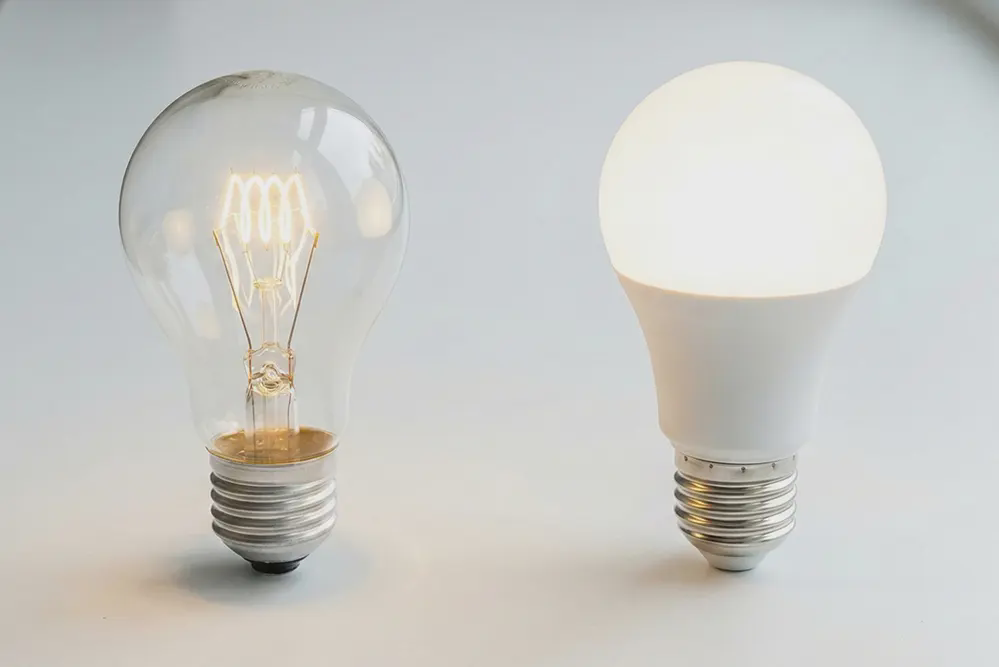
A 60-watt incandescent bulb produces 750-900 lumens, converting 20% of electrical energy into light. The other 80-90% becomes heat.
An LED producing 800 lumens needs only 6-8 watts, converting 80-90% of energy into light. The efficiency difference is massive.
An incandescent lasts about 1,000 hours. Quality LEDs last 25,000-50,000 hours—25 to 50 times longer. At 8 hours daily, an incandescent dies after 4 months. The LED keeps going for 8-17 years.
Real costs: At $0.12 per kilowatt-hour, a 60-watt incandescent costs about $21 yearly in electricity. An 8-watt LED costs $2.80 yearly.
Over 25,000 hours, you'd need 25 incandescent bulbs ($25) plus $525 in electricity—$550 total. One LED costs $5 plus $70 in electricity—$75 total. One LED bulb saves $475 over its lifetime.
LED vs CFL
CFLs last 8,000-10,000 hours and use 13-15 watts for 800 lumens. LEDs last 2.5-5 times longer, use slightly less energy (6-8 watts), and turn on instantly while CFLs need warm-up time.
The biggest advantage? CFLs contain mercury—a toxic heavy metal. Break a CFL and you're dealing with mercury vapor. LEDs contain no mercury, making them safer and easier to dispose of.
Most CFLs can't be dimmed properly, while many LEDs are designed for dimming.
LED vs Halogen
Halogen bulbs produce 20-25 lumens per watt. LEDs produce 80-100+ lumens per watt. Halogens run extremely hot—fire hazard if touching flammable materials. LEDs run cool.
Halogens last 2,000-4,000 hours versus 25,000-50,000 for LEDs. For track lighting or accent lighting where halogens were common, LEDs offer superior performance at lower operating costs.
Benefits and Advantages
Energy Efficiency
Replacing traditional bulbs with LEDs reduces lighting energy consumption by 75-90%. If lighting accounts for 10% of your electricity bill, that's an immediate 7-9% reduction in total costs.
The DOE estimates by 2035, LEDs could save 569 terawatt-hours annually in the US—more electricity than 92 large power plants produce yearly, massively reducing carbon emissions.
Exceptional Lifespan
LEDs don't burn out suddenly like incandescent bulbs. They experience lumen depreciation—gradually dimming over years. Rated "lifespan" is when brightness reaches 70% of original.
A 25,000-hour LED used 8 hours daily lasts 8.5 years. A 50,000-hour LED lasts over 17 years. Even then, it still works—just dimmer. Many LEDs continue functioning well beyond rated lifespan.
For commercial applications, this slashes maintenance expenses. Changing bulbs in 30-foot warehouse ceilings or along highway streets costs more in labor than bulb costs. LEDs eliminate frequent replacements.
Durability and Safety
LEDs are solid-state devices. No fragile filament or glass envelope. The chip is embedded in tough plastic. Drop an LED bulb and it'll probably survive—ideal for applications with vibration (vehicles), potential impacts (workshops), or safety hazards (children's rooms).
Incandescent bulbs get hot enough to cause burns or ignite materials. LEDs run cool—touchable when operating. Heat is minimal and concentrated in the heat sink.
LEDs emit virtually no UV radiation, safe for illuminating UV-sensitive materials like artwork. The absence of mercury makes them safer throughout manufacturing, use, and disposal.
Design Flexibility
LEDs' small size enables thin, flexible LED strips that bend around corners. You can embed LEDs in unexpected places and design fixtures impractical with bulky traditional components.
Directional emission puts light exactly where wanted without wasting energy. For recessed downlights or reading lamps, this is advantageous.
LEDs respond instantly—full brightness in nanoseconds. Switch them millions of times with no effect. This enables dimming, color changing, and smart home integration. Quality dimmable LEDs adjust from 100% to 10% smoothly. RGB LEDs change colors on command via apps or voice.
Common LED Applications
Residential
Standard screw-in LED bulbs replace incandescent in lamps and ceiling fixtures. Recessed downlights use LED retrofit kits for kitchens, hallways, bathrooms. Under-cabinet lighting uses LED strips or pucks. LED strips create accent lighting behind TVs, under toe-kicks, along stairs in single colors or RGB.
Commercial and Industrial
Office buildings use LED panels replacing fluorescent fixtures, cutting energy and maintenance. Warehouses benefit from LED high-bay fixtures withstanding vibration and temperature extremes. Retail uses LED track lighting. Parking lots, building exteriors, and signage switched to LEDs for energy savings and immediate on/off.
Automotive
New cars feature LED headlights, taillights, and interior lighting. LEDs are more reliable (no vibration failure), turn on instantly (important for brake lights), and allow distinctive light signatures. Dashboards use LEDs for clarity and low power draw.
Specialty
Horticulture uses LED grow lights with specific wavelengths (red and blue) for plant growth while using far less electricity. UV-C LEDs sterilize water, air, and surfaces. Medical devices use LEDs from examination lights to phototherapy. Display screens rely on LED technology. Traffic signals universally use LEDs—visible in bright sunlight, minimal power, lasting 5-10 years versus 6-12 months for incandescent. Infrared LEDs power remote controls and sensors.
Common Problems and Limitations
Flickering Issues
The most common complaint is flickering. The main culprit is incompatible dimmer switches. Traditional dimmers designed for incandescent behave differently from LEDs. Old dimmers with LEDs cause flickering (especially at low dim levels), buzzing, or limited dimming range.
Solution: Use dimmer switches labeled "LED-compatible." These are designed for LED electrical characteristics providing smooth, flicker-free dimming.
Secondary causes include voltage fluctuations (large appliances sharing circuits) and low-quality LED drivers.
Heat Management
LEDs emit far less heat than incandescent but still generate heat at the semiconductor junction. Quality LEDs include heat sinks—metal components absorbing and radiating heat away.
Problems occur when LEDs sit in enclosed fixtures without ventilation. Heat builds up, junction temperature rises, lifespan decreases. Some LEDs fail in months rather than years.
Solution: Look for LEDs rated for enclosed fixtures with better thermal management. Ensure adequate airflow. Heat also affects output—most LEDs produce less light when hot.
Higher Upfront Cost
LEDs cost more at purchase—$5-15 versus $1 for incandescent or $3 for CFL. But this is false economy.
That $5 LED lasts 25,000 hours. To get 25,000 hours from incandescent requires 25 bulbs ($25) plus significantly more electricity. Total cost of ownership—purchase plus energy over bulb life—strongly favors LEDs.
LED prices have dropped substantially. In 2008, LEDs cost $50-100. By 2024, quality LEDs sell for $5-15.
Color Inconsistency
LEDs from different manufacturers or batches might not match perfectly. Manufacturing tolerances cause slight color temperature variations. For most applications this doesn't matter, but multi-bulb fixtures or perfectly matched room lighting can show differences.
Solution: Buy bulbs from the same manufacturer and production batch. Quality manufacturers use "binning"—sorting LEDs by color characteristics ensuring consistency.
Dimming Compatibility
Not all LEDs are dimmable. Packaging should state "dimmable" explicitly. Using non-dimmable LEDs with dimmers causes flickering, buzzing, premature failure, or non-function.
Even dimmable LEDs require compatible dimmers. LED dimmers have minimum load requirements. If you replace five 60-watt incandescents (300 watts total) with five 8-watt LEDs (40 watts total), old dimmers might not work below minimum load.
Solution: Verify LED is marked "dimmable." Install LED-compatible dimmers rated for low wattages. Check dimmer minimum load requirements.
Understanding LED Specifications
Lumens measure brightness—total visible light emitted. 800 lumens equals a 60-watt incandescent. Common equivalents: 450 lumens = 40W, 1,100 lumens = 75W, 1,600 lumens = 100W.
Watts indicate power consumption. An 800-lumen LED typically uses 8-10 watts versus 60 for incandescent.
Color Temperature (Kelvin) describes appearance. 2700K is warm yellow for living rooms. 3000K is slightly cooler for dining rooms. 4000K is neutral white for kitchens. 5000-6500K is cool daylight white for workshops.
CRI (Color Rendering Index) measures color accuracy (0-100). Incandescents score 100; cheap LEDs 70-80; quality LEDs 80-90+. Above 80 is fine for most uses. Color-critical work needs 90+.
Beam Angle indicates focus. Narrow (25-40 degrees) creates spotlights; wide (100-120 degrees) provides room lighting.
IP Rating matters for outdoor LEDs. IP65 means dust-tight and water jet protected—suitable for most outdoor use.
Dimmable should be explicitly stated. Assume not dimmable unless marked otherwise.
FAQ
Q1: How long do LED lights really last?
Quality LEDs last 20,000-50,000 hours. At 8 hours daily, a 25,000-hour LED lasts 8.5 years before reaching 70% original brightness. A 50,000-hour LED lasts over 17 years. Even after this point, most LEDs continue working at reduced brightness.
Q2: Do LEDs get hot like incandescent bulbs?
LEDs emit far less heat. Incandescent bulbs waste 90% energy as heat—too hot to touch. LEDs convert 80-90% energy into light with only 10-20% as heat. You can safely touch operating LED bulbs, though heat sink areas may feel warm.
Q3: Why are some LED bulbs more expensive?
Price reflects quality in semiconductor chips, LED drivers, heat management, and manufacturing standards. Better chips produce consistent light and last longer. Superior drivers prevent flickering. Quality heat sinks extend lifespan. Cheap LEDs cut corners, leading to shorter life, flickering, or early failures.
Q4: Can I use LED bulbs with my existing dimmer switch?
Not always. Standard dimmers cause LED flickering or buzzing. You need LED-compatible dimmers specifically designed for LED characteristics. Additionally, the LED must be labeled "dimmable"—not all support dimming. Check manufacturer compatibility lists when possible.
Q5: What does 2700K vs 5000K mean?
Color temperature in Kelvin. 2700K produces warm yellow light like traditional bulbs—ideal for living rooms and bedrooms. 5000K produces cool white daylight—better for offices or garages where you need to see details clearly. Choose based on room purpose.
Conclusion
LEDs use semiconductor electroluminescence to convert 80-90% of electrical energy directly into light. The results: lifespans of 25,000-50,000 hours (versus 1,000 for incandescent), energy consumption reduced 75-90%, solid-state durability, instant operation, no toxic materials.
One LED bulb replaces 25-50 incandescent bulbs over its lifetime, saving hundreds in electricity and replacement costs. Switching to LEDs cuts lighting energy use by three-quarters.
If you're still using incandescent or CFL bulbs, switch now. Start with most-used lights for maximum savings.
Success requires smart selection. Check dimmer compatibility before purchasing. Choose color temperature based on room purpose: 2700K for warm living spaces, 4000-5000K for workspaces. Invest in quality products—ultra-cheap LEDs fail prematurely.
The LED revolution is here. The technology works, the economics favor it, and the environmental benefits are substantial.
- Pre: sorry!
- Next: Lifetime of LED: A Comprehensive Guide to Optimal Usage