
Shedding Light on Lumen in Lighting: A Bright Insight
- 2024-03-14 18:23
- UNITOP
Shopping for light bulbs has become confusing. The familiar wattage numbers—40W for a bedroom, 100W for a kitchen—no longer work with LED technology. An LED producing the same light as a 60-watt incandescent might use only 9 watts, while delivering identical or even better brightness.
This disconnect leaves consumers uncertain. How do you compare a 10-watt LED to a 60-watt incandescent? Which one is actually brighter? The answer lies in understanding one measurement that cuts through the confusion: lumens.
Lumens measure the actual brightness a bulb produces, regardless of the technology or energy consumption. Once you understand how lumens work, lighting decisions become straightforward again. You'll know exactly how bright a bulb will be, how much light your space needs, and how to compare products accurately.
This guide explains everything you need to know about lumens—from basic definitions to room-by-room calculations—helping you make confident lighting choices that save energy and money.
What Is a Lumen in Lighting?
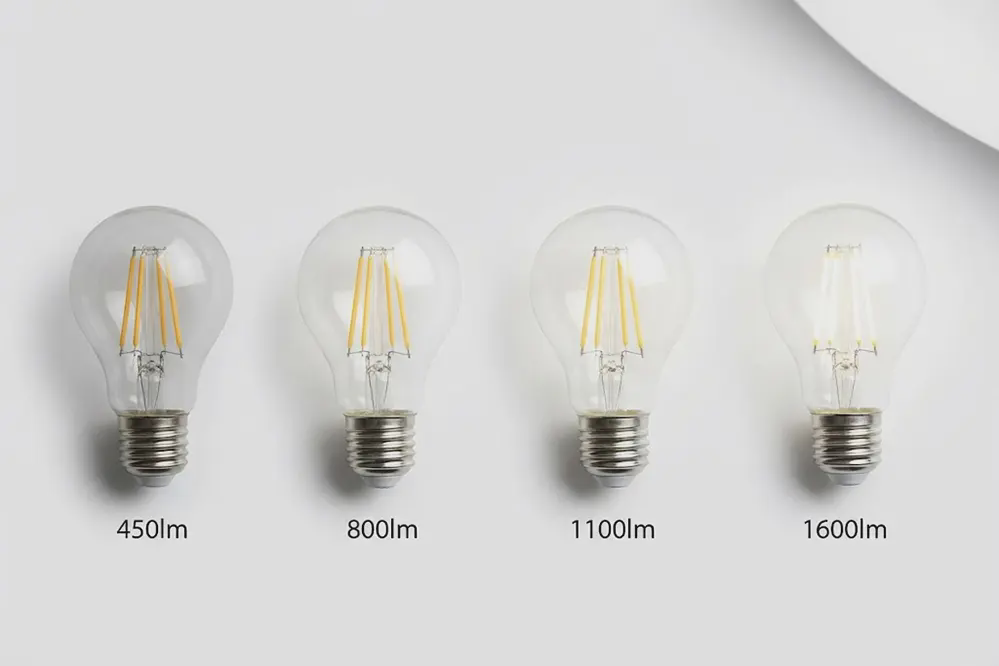
A lumen is a unit of measurement that quantifies the total amount of visible light emitted by a light source. Simply put, lumens measure brightness—more lumens mean brighter light that's easier to see by.
Technically, a lumen measures luminous flux, denoted by "lm." The word comes from Latin meaning "light," which makes the connection obvious once you know what it measures. Unlike watts, which measure electricity consumption and show up on your power bill, lumens measure actual light output—what you see and experience.
This distinction fundamentally matters. A 60-watt incandescent produces about 800 lumens, but a modern LED delivers those same 800 lumens using only 8-12 watts. The brightness you experience remains identical, but the energy consumption drops by 80% or more. The lumen measurement captures what matters most—how well-lit your space will be—independent of the underlying technology.
Lumens also account for how human eyes perceive different wavelengths. Our eyes respond more strongly to certain colors, particularly in the green-yellow range of the visible spectrum. A light source emitting more wavelengths in this range will register higher lumens even at identical energy input compared to sources emphasizing red or blue wavelengths. This biological reality makes lumens a practical, human-centered brightness measurement rather than a purely physical measurement of electromagnetic radiation.
Why Lumens Replaced Watts
For decades, wattage worked perfectly for bulb shopping. A 40-watt bulb gave soft bedroom light, a 100-watt bulb lit kitchens and living rooms. The system was simple and intuitive because incandescent bulbs dominated the market and had a predictable relationship: more watts meant more brightness. Everyone understood this correlation through everyday experience.
LEDs changed everything. These bulbs convert electricity to light with remarkable efficiency, producing far more brightness per watt than incandescent technology ever could. A 22-watt LED produces 1,600 lumens—twice the light of a 60-watt incandescent that produces only 800 lumens. A 6.5-watt LED matches a 50-watt halogen bulb. Suddenly, watts became meaningless for comparing brightness across different technologies.
The lighting industry needed a universal standard, and governments mandated the change. On September 1, 2010, the European Union required that lighting equipment be labeled in lumens rather than watts as part of the Eco-design Directive for Energy-using Products. The U.S. Federal Trade Commission followed with similar Lighting Facts label requirements for all general-service bulbs. The shift became law worldwide because watts no longer told consumers what they actually needed to know—how bright the bulb would be in their home or business.
Lumens vs Watts: The Critical Difference
Lumens and watts measure completely different things, yet the confusion between them remains widespread. Understanding this distinction is essential for making smart lighting choices in the LED era.
Lumens measure light output—the brightness you actually see when a bulb is lit. When a bulb produces 800 lumens, that number tells you exactly how much visible light reaches your eyes. More lumens mean more brightness, fewer lumens mean dimmer light. It's a direct measurement of the illumination result you care about.
Watts measure energy consumption—the electrical power your bulb draws from your electrical system. A 60-watt bulb uses 60 watts of electricity for every hour it operates. That number determines what appears on your monthly power bill, but it tells you absolutely nothing about brightness unless you already know the bulb's specific technology and efficiency characteristics.
Comparing lumens to watts is like comparing pounds to gallons—the measurements are fundamentally different units that can't be directly converted without knowing additional information about the specific technology being used.
With incandescent bulbs, the old correlation worked because the technology was consistent across all manufacturers. A 100-watt incandescent reliably produced about 1,600 lumens, while a 40-watt incandescent produced about 450 lumens. People learned these relationships through years of experience and used watts as a practical shorthand for brightness, even though that's not what watts actually measured.
The LED revolution completely shattered this comfortable correlation. Consider these real-world examples: A 22-watt LED bulb produces 1,600 lumens, making it substantially brighter than a 60-watt incandescent that produces only 800 lumens. A 6.5-watt LED lamp gives identical light output to a 50-watt halogen bulb—that's 87% less energy for exactly the same brightness. With CFLs, halogen, and various LED products entering the market, the old wattage-based shopping method became completely obsolete and actively misleading.
The practical takeaway is straightforward: when shopping for bulbs, look at lumens first to determine brightness levels, then check watts to understand energy costs and ensure compatibility with your fixtures. A bulb producing 1,600 lumens delivers identical brightness whether it uses 100 watts (old incandescent), 23 watts (CFL), or 18 watts (LED). The lumens—the actual light you see—stay constant across all these technologies. Only the energy consumption and your resulting electric bill change.
Luminous Efficacy: Lumens Per Watt
Luminous efficacy measures how efficiently a light source converts electrical energy into visible light, expressed as lumens per watt (lm/W). Think of it like miles per gallon for your car—higher numbers mean better efficiency, lower operating costs, and less environmental impact.
Calculate efficacy by dividing total light output in lumens by power consumption in watts. A bulb producing 800 lumens while using 10 watts achieves 80 lm/W. Another bulb producing those same 800 lumens but using only 8 watts reaches 100 lm/W—making it 25% more efficient and 25% cheaper to operate over time.
Different lighting technologies show dramatically different efficacy ratings, which explains why LED adoption has accelerated so rapidly:
Incandescent: 12-18 lm/W—The oldest technology still available converts only a tiny fraction of electrical energy into visible light. Most energy becomes heat rather than illumination, which is why incandescent bulbs get extremely hot to the touch and waste so much electricity.
Halogen: 16-24 lm/W—An improved incandescent design that performs slightly better but remains highly inefficient by modern standards.
CFL (Compact Fluorescent): 50-100 lm/W—Represented a major efficiency leap, allowing 60-75% energy savings compared to incandescent. However, CFLs have drawbacks including warm-up time, mercury content requiring special disposal, and light quality many people find harsh or unpleasant.
LED: 75-200+ lm/W—Current technology, with commercial products typically delivering 130-190 lm/W and laboratory results exceeding 200 lm/W. LEDs achieve 7 to 15 times better efficiency than the incandescent bulbs they replace, and the technology continues improving.
The cost savings from higher efficacy are substantial and immediate. Consider two LED panels with similar total light output: one produces 3,500 lumens using 23 watts (152 lm/W), while another produces 3,600 lumens using 45 watts (80 lm/W). The first panel uses nearly half the power to produce essentially identical brightness. Over a year of operation, the 152 lm/W panel costs 51% less to run than the 80 lm/W panel. Multiply this by every fixture in your home or business, and the savings become significant.
When shopping, you won't usually see lumens per watt listed directly on packaging. Instead, you'll find total lumens and wattage printed separately. Calculate efficacy yourself by dividing lumens by watts: a bulb listing 1,600 lumens and 16 watts achieves 100 lm/W. This simple calculation helps you compare true efficiency across different products and manufacturers.
Higher-efficacy bulbs typically cost more upfront, causing some shoppers to choose cheaper alternatives. However, the payback period for quality LED bulbs is remarkably short—usually 2 to 4 years based on typical residential usage patterns. After that initial payback, the energy savings continue accumulating and go directly to your bottom line for the remaining 15 to 25 years the LED bulb operates.
Lumens to Watts Conversion Chart
Quick conversion guide for replacing incandescent bulbs with LEDs:
25W incandescent = 230-270 lumens → 4-5W LED
40W incandescent = 450 lumens → 6-9W LED
60W incandescent = 800 lumens → 8-12W LED
75W incandescent = 1,100 lumens → 13-15W LED
100W incandescent = 1,600 lumens → 18-22W LED
Many manufacturers print "wattage equivalent" labels (like "100-watt equivalent"), but always verify actual lumen output to ensure you get the brightness you need.
How to Calculate Lumens for Your Space
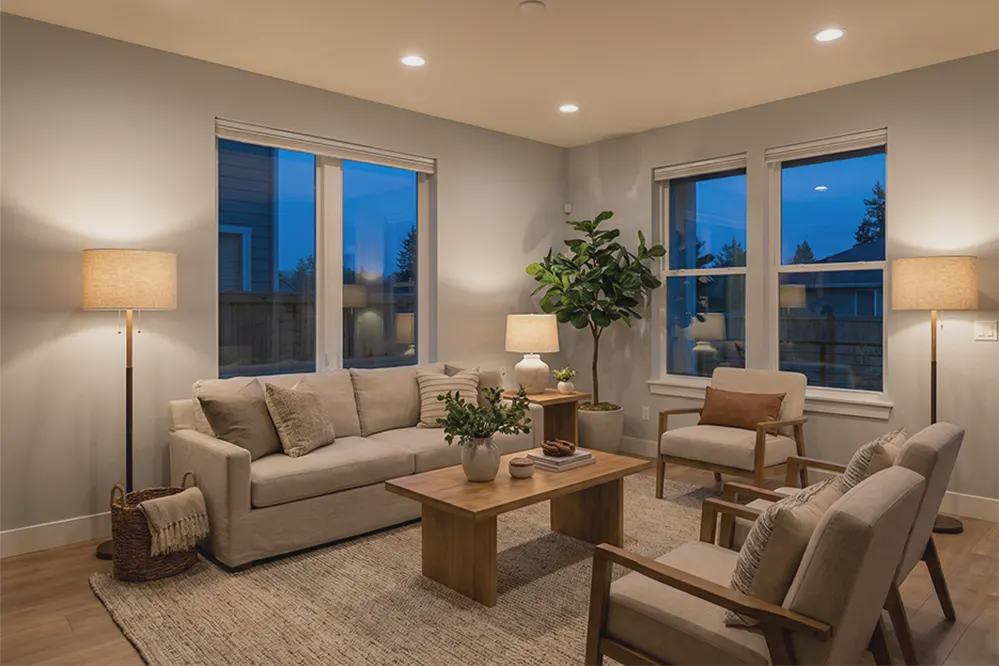
The lumen method uses foot-candles (lumens per square foot) to determine lighting needs. One foot-candle equals one lumen per square foot.
Three-step process:
Measure room area: Length × width in square feet (10 ft × 12 ft = 120 sq ft)
Determine foot-candle need: Living rooms need 10-20 fc, kitchens need 30-80 fc
Calculate total lumens: Square footage × foot-candles (120 sq ft × 15 fc = 1,800 lumens)
Adjustment factors:
Ceiling height: Add 20-30% for ceilings over 10 feet
Wall color: Dark walls need 10-20% more; light walls need 10-15% less
Age: People over 60 need 20-30% more light
Task vs ambient: Task areas need higher foot-candles than general spaces
Room-by-Room Lumen Requirements
Living rooms: 1,500-3,000 lumens (10-20 lm/sq ft). Use layered lighting with overhead fixtures, floor lamps, and table lamps.
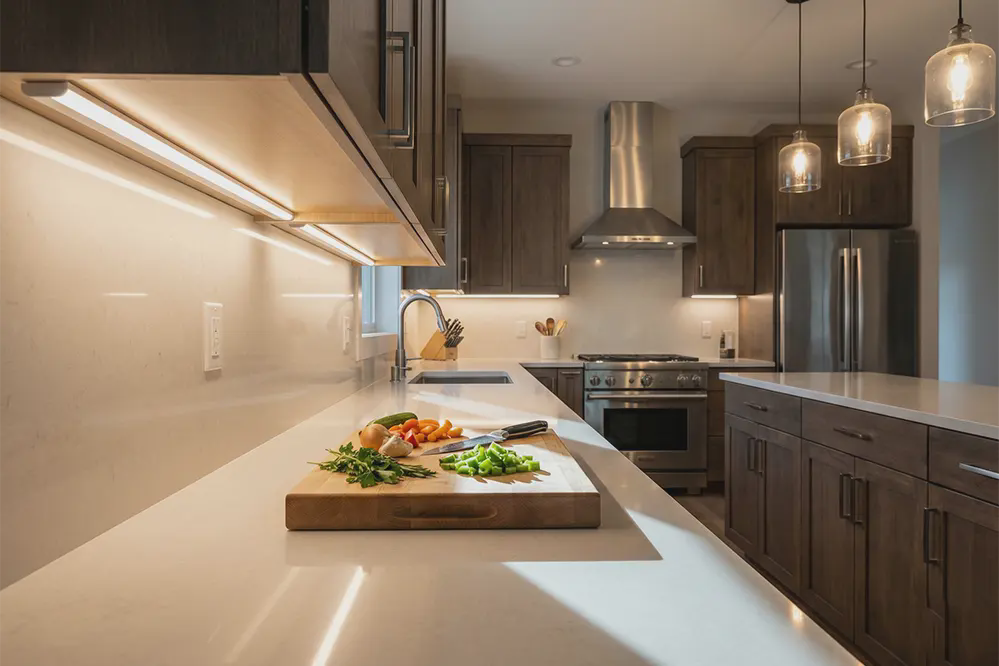
Kitchens: 4,000-8,000 lumens (30-80 lm/sq ft). General overhead: 30-40 lm/sq ft. Task areas (counters, island): 70-80 lm/sq ft.
Bedrooms: 2,000-4,000 lumens (10-20 lm/sq ft). Add 400-700 lumen reading lamps. Dimmer switches add flexibility.
Bathrooms: 4,000-8,000 lumens (70-80 lm/sq ft). Focus brightness around vanity for grooming tasks.
Home offices: 3,000-6,000 lumens (30-50 lm/sq ft). Reduces eye strain during computer work.
Hallways: 1,200-2,500 lumens. Adequate for safety and welcoming atmosphere.
Dining rooms: 3,000-4,000 lumens (30-40 lm/sq ft). Dimmers allow bright task lighting or intimate ambiance.
Adjust upward 20-30% for high ceilings, dark walls, or older occupants.
Commercial Lighting Standards
Offices: 30-50 foot-candles (3,000-6,000 lumens per 100 sq ft). Improves concentration and reduces headaches.
Warehouses: 10,000-30,000 lumens per high-bay fixture. Safety requires 30-50 fc at floor level despite 20-40 ft mounting heights.
Retail: 2,000-8,000 lumens per fixture. Requires CRI 90+ for accurate color rendering.
Restaurants: 1,500-4,000 lumens. Lower for ambiance, higher for food prep areas.
Parking lots: 10,000-20,000 lumens per pole. Targets 2-5 fc at ground level for safety.
OSHA minimum: 30 foot-candles on work surfaces—a legal requirement, not a recommendation.
Lumens and Related Lighting Metrics
Lumens vs Lux: Lux measures lumens per square meter. 1,000 lumens in 1 sq meter = 1,000 lux. Same lumens in 10 sq meters = 100 lux. Larger areas need more lumens for equivalent brightness.
Lumens vs Candela: Candela measures directional intensity. 1 candela ≈ 12.57 lumens. Matters for spotlights where focused beam intensity is critical.
Lumens vs Foot-candles: Foot-candle = lumens per square foot. 1 foot-candle = 10.57 lux. Professional standards use foot-candles.
Useful Lumens: EU standard measuring light within a 90-degree cone. More accurate for spotlights than total lumens, which includes "spill light."
CRI (Color Rendering Index): Measures color accuracy. CRI 80+ for general use, CRI 90+ for retail and color-critical applications.
Color Temperature and Lumens
Color temperature (Kelvin) and lumens are independent—you can have any Kelvin at any lumen level. However, cooler temperatures (5000K+) appear brighter than warm temperatures (2700K) at identical lumens.
Warm white (2700K-3000K): Cozy, yellowish. Ideal for living rooms, bedrooms
Neutral white (3500K-4100K): Balanced. Good for kitchens, bathrooms
Cool white/Daylight (5000K-6500K): Crisp, bluish. Best for task lighting, garages
Match temperature to function: a 3,000-lumen office at 4000K supports focus; a 2,500-lumen bedroom at 2700K promotes relaxation.
Dimming and Adjustable Brightness
Dimming reduces lumen output—a 1,000-lumen bulb at 50% brightness produces about 500 lumens. This flexibility lets one fixture serve multiple needs: full brightness for tasks, dimmed for ambiance.
Dimming also saves energy and extends bulb life. Always buy "dimmable" bulbs if using dimmer switches—standard LEDs may flicker or fail. Verify dimmer compatibility with LED technology.
Smart strategy: Install higher-lumen fixtures than needed, then dim to appropriate levels for different activities.
The Lighting Facts Label
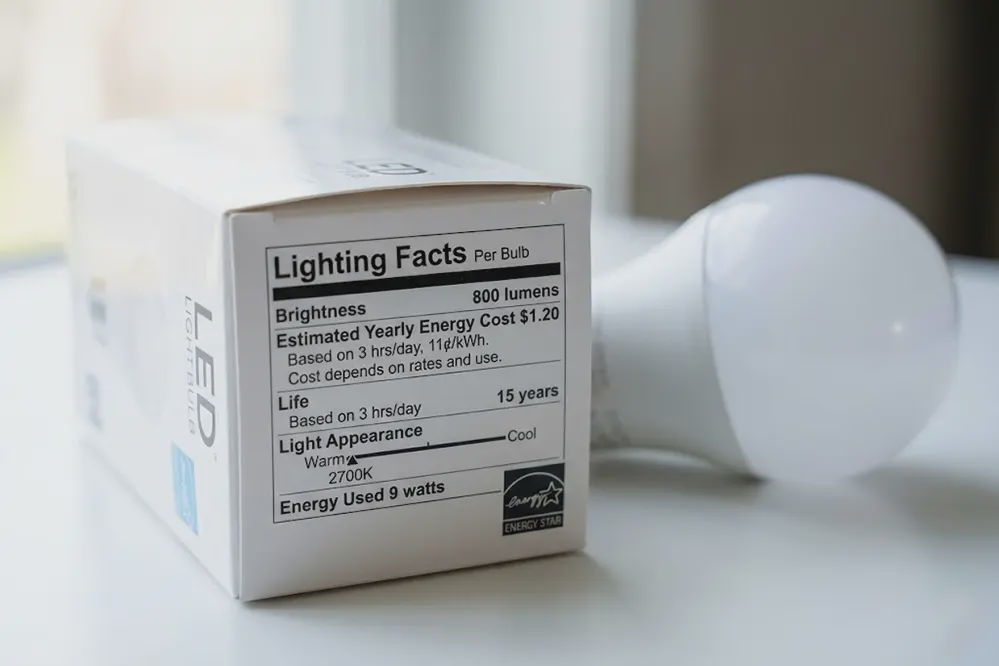
The FTC requires a Lighting Facts label on all bulbs—similar to nutrition labels on food.
Key information:
Brightness (lumens): Most prominent—the primary shopping criterion
Estimated yearly cost: Based on 3 hours daily use
Life expectancy: Years of expected operation
Light appearance: Color temperature on a warm-to-cool scale
Energy used: Actual wattage
ENERGY STAR logo: If certified for efficiency
Additional details include mercury content (for CFLs) and design voltage. Labels must also be posted online for six months after discontinuation.
Common Lumens Mistakes
"More is always better": Over-lighting wastes energy and creates uncomfortable glare. Match light levels to actual needs.
Ignoring beam angle: A 500-lumen spotlight (20° beam) appears much brighter than a 500-lumen flood (120° beam)—both produce identical lumens but concentrate differently.
Forgetting distance: The inverse square law means light intensity drops dramatically with distance. A source providing 100 fc at 5 feet provides only 25 fc at 10 feet.
Directional vs omnidirectional: LEDs emit directionally (120-180°). Incandescents radiate 360°. An 800-lumen LED may deliver more usable downward light than an 800-lumen incandescent.
Lumen depreciation: All bulbs dim over time. Quality LEDs maintain 70-80% of initial brightness after 50,000 hours—normal aging, not defect.
Fixture efficiency: Poor reflectors or diffusers mean a 1,000-lumen bulb might deliver only 600-700 lumens to your room.
Practical Lighting Tips
Match lumens to application first—determine brightness needs before considering watts
Calculate total needs: Square footage × foot-candles for your room type
Layer lighting: Multiple sources (ambient + task + accent) beat one bright fixture
Use dimmers: Install 20-30% more lumens than needed, then adjust down
Check efficacy: Higher lm/W means lower operating costs over 15-25 years
Account for room factors: Add 10-30% for dark walls, high ceilings, or older occupants
Plan for flexibility: Different times of day need different brightness levels
FAQ
What are lumens in LED lights?
Lumens measure total visible light emitted. An LED producing 800 lumens appears as bright as a 60W incandescent producing 800 lumens, but uses only 8-12 watts.
How many lumens should a light be?
Depends on room type. Living rooms: 1,500-3,000 lumens. Kitchens: 4,000-8,000 lumens. Bedrooms: 2,000-4,000 lumens. Rule of thumb: multiply square footage by 10-20 for living spaces, 70-80 for task areas.
What does 800 lumens equal in watts?
800 lumens ≈ 60W incandescent, 13W CFL, or 8-12W LED. Wattage varies by technology; brightness (lumens) stays constant.
How bright is 800 lumens?
Equivalent to a standard 60W incandescent—sufficient for comfortable reading or general lighting in 60-80 square feet.
How bright is 1000 lumens?
Provides strong task lighting for workspaces—brighter than 60W incandescent (800 lumens), less than 75W (1,100 lumens). Good for kitchen counters and offices.
Is 3000 lumens too bright for a bedroom?
From one fixture, yes. Distributed across multiple sources (1,500 lm ceiling + two 750 lm lamps), it's fine. Use dimmers for flexibility.
What is 6000K in lumens?
These measure different things. Kelvin (6000K) = color temperature (cool, bluish light). Lumens = brightness. Any Kelvin can be any lumen level.
Do LED lumens dim over time?
Yes. Quality LEDs maintain 70-80% of initial brightness after 50,000 hours (10-15 years typical use). Gradual dimming is normal, not defective.
Can you have too many lumens?
Yes. Over-lighting causes glare, eye strain, and wastes energy. Use recommended foot-candle levels for room types.
How do I convert lumens to lux?
Lux = lumens ÷ square meters. Example: 1,000 lumens over 10 sq meters = 100 lux. In imperial: foot-candles = lumens ÷ square feet. 1 fc ≈ 10.57 lux.
Conclusion
Lumens have become the gold standard for measuring brightness across all lighting technologies. Understanding lumens eliminates confusion and helps you make decisions based on actual light output rather than outdated wattage assumptions.
Think lumens first, watts second. Determine how many lumens you need using room calculations or conversion charts, then check wattage for energy costs and fixture compatibility. This sequence leads to better lighting and lower electricity bills.
For your next project, calculate room-specific lumen needs, distribute lighting across multiple fixtures, add dimmers for flexibility, and check lumens-per-watt for efficiency. LED technology continues advancing—commercial products now deliver 130-190 lm/W, with 200+ lm/W emerging. Understanding lumens ensures you can take advantage of these improvements while making confident decisions about brightness and energy consumption.