
CRI in Lighting: Why It Matters for Your LED Projects
- 2024-03-14 02:32
- UNITOP
You've invested $50,000 in a retail display that looks stunning under daylight. The products are arranged perfectly, colors coordinate beautifully, and everything pops. Then evening comes and your LED lights take over. Something feels off. Colors look flat and lifeless. That vibrant red dress appears brownish. Your carefully curated color scheme falls apart. Customers notice, even if they can't articulate why the display doesn't look as appealing as it did during the day.
The culprit? Poor Color Rendering Index. It's costing you customer perception, brand reputation, and ultimately sales.
Understanding CRI is the difference between LED lighting that enhances your space and lighting that undermines everything you've built. Whether you're specifying lights for a restaurant, retail store, healthcare facility, or residential project, getting CRI right matters. This guide cuts through the confusion and gives you practical knowledge for smart LED lighting decisions that deliver real results.
Color Rendering Index (CRI) measures how accurately a light source reproduces object colors compared to natural sunlight on a scale from 0 to 100, where higher values indicate better color fidelity.
What Is CRI in Lighting?
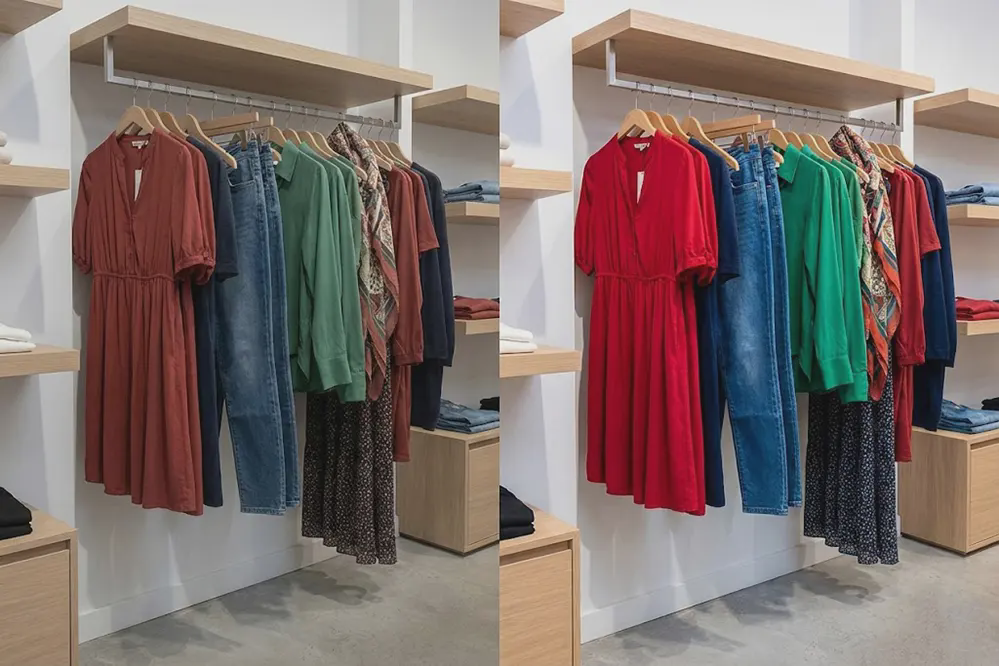
Color Rendering Index quantifies how well an artificial light source reveals true colors of objects compared to natural daylight. Think of it as a report card for light quality where sunlight earns a perfect score. CRI 100 shows colors exactly as they appear under natural sunlight—the gold standard for accurate color perception. CRI 50 distorts colors significantly, making reds look brown, greens appear muddy, and everything washed out and lifeless.
The scale runs from 0 to 100, though most artificial lights fall between 60 and 98. At the extreme low end approaching zero, all colors would look essentially the same—imagine viewing the world through a severely muted filter. At CRI 100, you're seeing colors with perfect accuracy, as if standing in bright natural daylight.
The CRI number on LED packaging (called "Ra") is the average of eight color samples measured in controlled laboratory conditions. These samples—designated R1 through R8—cover pastel tones from light red to bluish purple. Scientists chose these particular colors because they represent typical objects we encounter in daily life under various lighting conditions.
But here's the critical limitation: standard CRI stops at eight pastel colors. Extended CRI includes seven additional saturated colors (R9 through R15), revealing performance problems that the standard Ra score completely hides. This matters because the omitted colors—especially saturated red—are precisely the ones that reveal whether a light source truly delivers quality color rendering or just tests well on paper.
How CRI Is Calculated and Measured
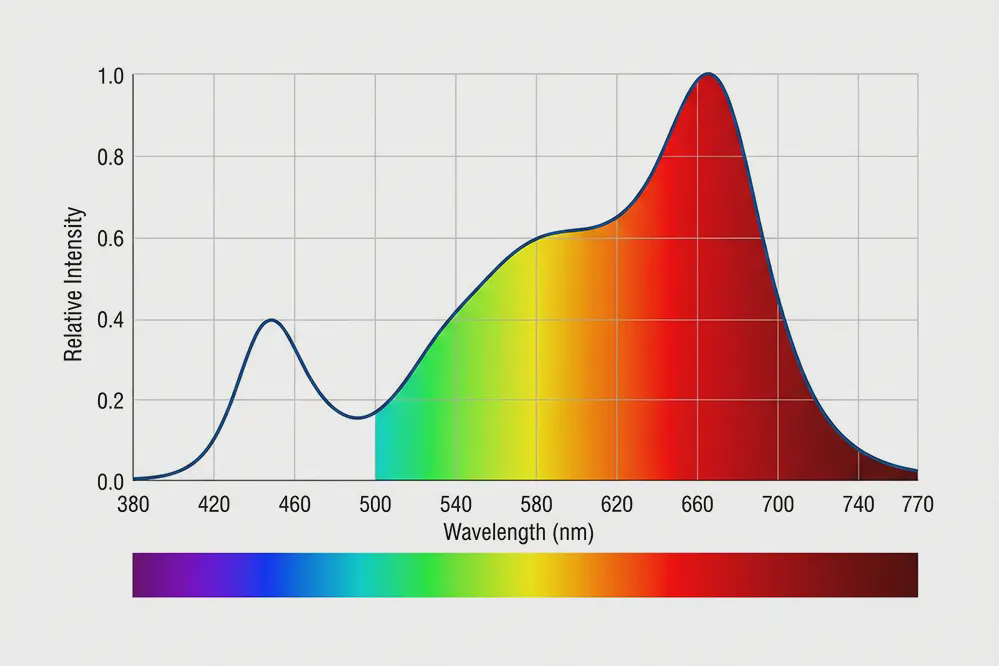
Manufacturers use a specialized instrument called a spectrophotometer in controlled laboratory environments to determine CRI. The process compares how eight standardized color samples look under the test light versus a reference light source at the same color temperature. This ensures apples-to-apples comparison.
For each of the eight samples, the instrument measures reflected light and calculates how different it appears from the reference. These differences are converted into scores from 0 to 100 for each individual color. The eight scores are then averaged to produce the final Ra value—the number you see marketed as "CRI" on product packaging.
The reference standard depends on the light's color temperature. For warm lights below 5000K, the reference is a theoretical blackbody radiator—essentially a perfect heat-based light source like the sun or a candle. For cooler lights above 5000K, it's calculated daylight. This is why incandescent bulbs naturally score CRI 100—they are blackbody radiators being compared to themselves, creating the perfect baseline.
Extended CRI testing follows the same methodology but adds seven additional color samples: R9 (saturated red), R10 (saturated yellow), R11 (saturated green), R12 (saturated blue), R13 (Caucasian skin tone), R14 (leaf green), and R15 (Asian skin tone). These aren't averaged into the standard Ra calculation, but they reveal critical performance characteristics that the eight pastel samples miss entirely. This is especially important for saturated colors and skin tones that are vital in real-world applications.
The LED Evolution: Why CRI Matters More Than Ever
In the incandescent era, CRI wasn't something lighting designers worried about. Incandescent bulbs heat tungsten filaments until they glow, creating a continuous spectrum of light wavelengths remarkably similar to natural sunlight. This continuous spectrum naturally yields excellent color rendering, typically 95-100 CRI. When you flipped a switch, you got great color rendering automatically without thinking about it.
Fluorescent lighting changed that comfortable reality. Fluorescents work differently—they excite mercury vapor to produce ultraviolet light that hits phosphor coating to create visible light. This process creates discrete spectral spikes rather than smooth continuous curves, yielding CRI values ranging from 50 for cheap fluorescents to about 85 for high-quality multi-phosphor versions. Those harsh, color-distorting office lights everyone complained about.
LEDs initially presented even worse challenges for color rendering. Most white LEDs use a blue LED chip coated with yellow phosphor. The combination appears white but creates significant gaps in the red portion of the spectrum—early LED products scored 70-80 CRI with particularly poor red rendering.
The LED industry has made remarkable progress through years of research and development. Advanced phosphor formulations and multi-chip designs now routinely achieve 90-95 CRI, with premium products reaching 95-98. Some specialized LEDs even claim 99 CRI, approaching incandescent perfection.
But CRI matters more now precisely because LEDs dominate every market segment. Unlike incandescents with automatic good rendering, LEDs require careful specification and verification. Two identical-looking LED bulbs can have wildly different CRI values and color rendering performance. The responsibility now falls squarely on buyers to understand CRI and specify correctly for their specific applications.
CRI vs Color Temperature: Understanding the Critical Difference
This confusion costs money every day. Someone walks into a showroom wanting "warm, natural light," sees a 2700K bulb, and assumes warm color temperature automatically means good color rendering. Wrong assumption, costly mistake.
Color temperature and CRI measure completely different lighting characteristics. Color temperature (measured in Kelvin) describes the color appearance of the light source itself—whether it looks warm and yellowish like candlelight (2700K), neutral like noon daylight (4000K), or cool and bluish like overcast sky (5000K-6500K). It's about how the light appears to your eye when you look at the fixture.
CRI, meanwhile, measures how accurately that light reveals the colors of objects it illuminates. These are independent specifications that both need careful consideration.
You can have a 2700K warm white LED with CRI 80 that looks warm but makes colors appear dull and washed out. You can also have a 2700K warm white LED with CRI 95 that looks equally warm but makes colors pop with stunning vibrancy and accuracy. Both produce the same warm, yellowish light—but one renders colors beautifully while the other distorts them.
Real example that happens frequently: A restaurant designer specifies 2700K lighting to create an intimate, cozy atmosphere. Smart move—warm color temperatures enhance comfort and traditionally make food look more appealing. But if they choose 2700K bulbs with CRI 75, the warm color appearance will be right, but food colors will look dull and unappetizing. Tomato sauce appears brownish instead of rich red. Fresh greens seem lifeless and pale. The designer needed to specify both 2700K and CRI 90+ to achieve both the warm atmosphere and accurate food color rendering that drives appetite appeal.
Color temperature creates mood and atmosphere. CRI ensures color accuracy and quality. Both specifications work together in professional lighting design, and you must get both right to achieve optimal results.
The R9 Problem: What Your CRI Rating Isn't Telling You
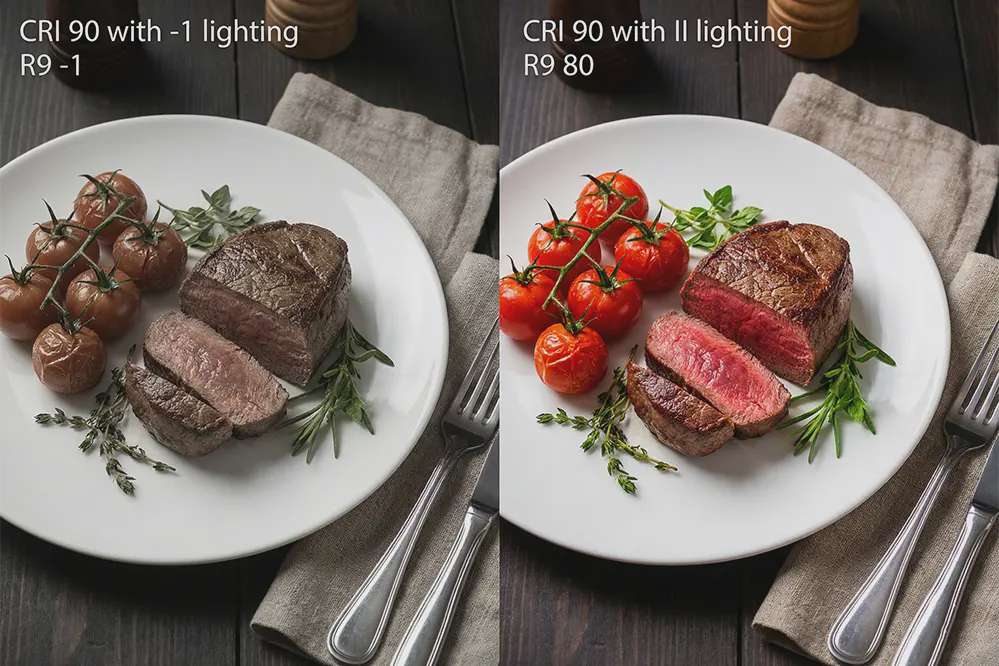
Here's the lighting industry's dirty secret: A light source can have CRI 90 and still make reds look terrible. The answer lies in the R9 value.
Those eight color samples (R1-R8) used for CRI? All pastel tones—light pink, soft yellow, pale green. None are saturated colors. A light can perform well on these pastels and score CRI 90 while completely failing at saturated red.
R9 measures saturated red rendering—fire engine red, not pale pink. It's excluded from the standard Ra calculation. Many LEDs marketed as "high CRI" have terrible R9 values.
I've tested LEDs claiming CRI 90 with R9 values of -1. Yes, negative one. An LED with CRI 90 but R9 of -1 makes red accent walls look brownish and muddy. It makes skin tones appear pale or greenish because healthy skin contains red undertones from blood beneath the surface.
Why does this happen? Most LED manufacturers optimize phosphor formulations to score well on the eight standard samples. Hitting high R9 requires additional red phosphor—higher cost, lower efficiency. Budget LEDs achieve respectable Ra scores while failing at red rendering.
R9 matters enormously in real applications. In restaurants, it affects food appearance—meats, sauces, fruits, vegetables. In retail, it determines whether red clothing looks vibrant or drab. In medical settings, it impacts diagnostic accuracy for skin conditions. In residential spaces, it affects how people look and feel.
R9 thresholds:
- R9 > 0: Energy Star minimum (unacceptably low)
- R9 > 50: Good quality reds (practical minimum)
- R9 > 80: Excellent rendering (premium applications)
Always request R9 values from suppliers. If they won't provide data, assume it's bad. Reputable manufacturers have R9 documentation readily available.
CRI Ranges Decoded: What the Numbers Really Mean
CRI 95-100: Phenomenal color rendering. Colors appear exactly right. Skin tones look healthy. Artwork reveals intended palette. Paint and finishes show true depth. Used in Hollywood studios, high-end retail, art galleries, museums, printing shops. Premium price but worth it when color accuracy impacts business outcomes.
CRI 90-95: Great color rendering. Almost all colors display vibrantly. The teal backsplash looks fully saturated and true to the sample. Ideal for upscale restaurants, hotels, better retail, modern offices, residential living areas. The quality sweet spot.
CRI 80-90: Good color rendering. Most colors render reasonably well. Acceptable baseline for general commercial—standard offices, moderate retail. Adequate but not impressive.
CRI Below 80: Poor color rendering. Colors look desaturated, drab, sometimes unidentifiable. Only acceptable for parking garages, warehouses, streetlights, outdoor security where color doesn't matter.
Industry-Specific CRI Requirements for LED Projects
Retail and Fashion: 90+ CRI, R9 > 50. Color accuracy drives sales. High-end fashion often uses 95 CRI, R9 > 80.
Hospitality and Restaurants: 90-95 CRI, R9 > 50. Food presentation and flattering skin tones matter.
Healthcare and Medical: 90-97 CRI. Diagnostic accuracy depends on color perception. General practice needs 90 minimum; hospitals should use 95-97.
Art Galleries and Museums: 95-98 CRI with high R9 to honor artistic intent.
Residential Spaces: 90+ for living rooms, bedrooms, kitchens, bathrooms. Utility spaces can use 80+.
Photography and Film: 95+ CRI plus TLCI data for camera sensor compatibility.
Industrial and Warehouse: 70-80 CRI acceptable. Prioritize efficiency over color.
Offices: 80-90 for general work, 90-97 for color-critical tasks.
The CRI Trade-Off Nobody Talks About
Higher CRI costs you lumens. At the same wattage, CRI 95 produces 5-15% fewer lumens than CRI 80.
The physics: High CRI requires phosphor formulations that convert LED light across broader spectrum, including more red. This is less efficient than narrow-spectrum conversion.
Example comparison:
- Fixture A: 80 CRI, 5000 lumens, $150
- Fixture B: 95 CRI, 4250 lumens, $220
Fixture B gives 15% fewer lumens and costs 47% more.
This matters for large spaces requiring specific illumination levels. High CRI means more fixtures to hit targets, driving up costs.
Prioritize efficiency when color has zero impact on function—parking structures, storage, exterior security.
Prioritize CRI when perception, decision-making, comfort, or brand matter. The cost difference is worth it when color affects how people feel, buy, or perform tasks.
Common CRI Buying Mistakes in LED Projects
Mistake 1: Assuming all "90 CRI" are equal. One might have R9 of 50, another R9 of -5. Always request full spectral data or R9 minimum.
Mistake 2: Ignoring R9 values. You specify CRI 90 thinking you've ensured quality, then discover reds look terrible. Request R9 data always.
Mistake 3: Confusing CRI with CCT. Warm white doesn't mean good color rendering. Specify both temperature and CRI.
Mistake 4: Over-specifying CRI. CRI 95 for warehouses wastes money. Match specification to actual needs.
Mistake 5: Under-specifying CRI. Saving $30/fixture in retail by dropping to CRI 80 when color drives sales.
Mistake 6: Accepting claims without verification. Request LM-79 reports from independent labs.
Mistake 7: Ignoring brightness trade-off. High CRI means fewer lumens. Calculate fixture counts accordingly.
Beyond CRI: Modern Color Quality Metrics
TM-30-15/18 is the modern CRI replacement. Instead of 8 colors, it evaluates 99. Provides two metrics: Fidelity Index (Rf) measures accuracy, Gamut Index (Rg) measures saturation. A color vector graphic shows which hues are oversaturated or undersaturated.
TM-30 catches problems CRI misses. An LED might score CRI 90 while severely distorting blues—TM-30's 99 samples reveal this.
Color Quality Scale (CQS) uses 15 saturated colors and accounts for human preferences.
TLCI (Television Lighting Consistency Index) tests performance for cameras, not eyes. Essential for photography and film.
When to use which: CRI (Ra) plus R9 suffices for most projects. Request TM-30 for high-end applications. TLCI for video/photography.
CRI persists despite better alternatives due to industry inertia—it's been standard since 1974.
How to Specify CRI for Your LED Project
Step 1: Assess color requirements. Does color perception impact this space? Will decisions be based on color?
Step 2: Set minimum threshold.
- Color-critical: CRI 90 minimum
- Professional: CRI 80-90
- Utility: CRI 70-80
Step 3: Decide on R9. For most human-presence applications, yes. Specify R9 > 50 standard, R9 > 80 premium.
Step 4: Balance with budget. Calculate fixtures needed, accounting for reduced high-CRI output.
Step 5: Request documentation:
- Ra value with proof
- R9 value
- Spectral power distribution
- LM-79 test reports
- TM-30 data for critical applications
Step 6: Verify with samples for large projects.
Red flags:
- No R9 data available
- Missing third-party reports
- Prices too good for claimed CRI
- Vague "excellent color" claims
Professional specification example: "LED downlights shall have minimum CRI (Ra) 92, R9 minimum 65, CCT 3000K ±200K. Supplier shall provide LM-79 reports from NVLAP-accredited lab."
FAQ
Q: Is 80 CRI good enough for LED strip lighting in my project?
A: Depends on application. For living rooms, bathrooms, retail displays—anywhere color matters—80 CRI is bare minimum; target 90+. For utility spaces like workshops, 80 works. LED strips are affordable enough that the price difference between 80 and 90 CRI is minor—don't compromise.
Q: What's more important for my LED project: CRI or lumens?
A: Match to purpose. Color-critical spaces (retail, restaurants, galleries, residences) prioritize CRI 90+ even at efficiency cost. Task-oriented spaces (warehouses, parking, outdoor security) prioritize lumens since color has minimal impact. Most commercial offices need both—CRI 80-90 and adequate illumination.
Q: Can you actually see the difference between 90 and 95 CRI?
A: Yes, especially in color-rich environments. Most noticeable in retail displays, art galleries, food presentation, residential spaces with varied finishes. People perceive one environment as richer and more vibrant. In side-by-side testing, most prefer 95 over 90. In utilitarian spaces, difference is negligible.
Q: Why do some 90 CRI LEDs look worse than others with the same rating?
A: R9 value. An LED can score CRI 90 while having R9 of -1, rendering reds terribly. Since R9 isn't in Ra calculation, manufacturers hit "90 CRI" while delivering poor red rendering. Also, CRI 90 is a range—one fixture might score 90.1, another 94.8. Always request R9 values and spectral data.
Q: Does high CRI affect LED lifespan or energy efficiency?
A: High CRI reduces efficiency 5-15% (fewer lumens per watt) but doesn't impact lifespan. The phosphor needed for broader spectrum is less efficient at converting to lumens. Rated hours to 70% output remains comparable between 80 and 95 CRI using quality components. Marginally higher energy costs, but performance benefit outweighs it for color-critical projects.
Conclusion
Color Rendering Index isn't just another spec—it's the difference between lighting that enhances and lighting that undermines. Between colors that pop and colors that fall flat.
Key takeaways: CRI matters whenever perception, comfort, or decisions are involved. R9 value is as important as overall CRI—always request it. Match CRI to actual needs, not marketing. Higher CRI means efficiency trade-offs—account for reduced lumens. Always request Ra and R9 from suppliers with third-party reports. Consider TM-30 for mission-critical applications.
Use the specification framework in this guide for your next LED project. Request the right data, ask the right questions, and balance color quality with efficiency and budget. When you get CRI right, everything looks better.
Looking to enhance your lighting projects with high CRI LED strip lights and neon strips? Look no further than Unitop! We offer top-quality LED lighting solutions that will elevate your space. Contact us today to find the perfect high CRI options for your needs. Let Unitop illuminate your world with the power of CRI!