
LED Binning Explained: Enhancing Efficiency in Lighting Design
- 2024-03-12 13:48
- UNITOP
You've specified the perfect color temperature for your architectural lighting project—3000K warm white throughout. The fixtures arrive, you install them, and then you see it: one section glows slightly yellow, another leans cooler. Same manufacturer, same model, same order. What happened?
LED binning is the manufacturing process of sorting individual LEDs into groups based on color temperature, brightness, and voltage to ensure consistent performance in lighting applications. This quality control step determines whether your lighting installation delivers seamless uniformity or frustrating inconsistency.
In this guide, you'll learn how binning works, why it matters for lighting design efficiency, and how to specify the right binning tolerances to balance performance and cost for your projects.
What is LED Binning?
LED binning is the quality control process manufacturers use to categorize light-emitting diodes by their color, luminous flux, and forward voltage characteristics. During production, every LED chip is individually tested and assigned to a specific "bin" based on how closely its performance matches target specifications.
Here's the reality: manufacturing LEDs is complex. The process involves growing semiconductor crystals, cutting wafers, applying phosphor coatings, and packaging components. Despite precise manufacturing controls, natural variations occur at every step. Two LEDs from the same production run can emit slightly different colors, brightness levels, and require different voltages to operate.
Without binning, installing multiple LEDs from the same product family would be unpredictable. You might get perfectly matched units, or you might get visible differences that compromise visual quality. Binning eliminates this uncertainty by grouping LEDs with similar characteristics, so when you specify a bin, you know exactly what performance to expect.
Why Manufacturing Variations Are Inevitable
Even with advanced production technology, LED manufacturing involves inherent variability. Understanding why helps you appreciate why binning exists and why tighter bins cost more.
Semiconductor crystal growth forms the foundation of LED production. As crystals grow on wafers, microscopic variations in temperature, pressure, and material composition create slight differences in the semiconductor structure. A temperature fluctuation of just a few degrees during epitaxial growth can shift the dominant wavelength of emitted light.
Wafer-to-wafer differences compound these variations. Each silicon wafer produces hundreds or thousands of LED chips, but wafers from different production batches—or even different positions in the same growth chamber—exhibit measurable performance differences.
The phosphor coating process adds another layer of variability. White LEDs work by coating a blue LED chip with yellow phosphor. The phosphor converts some blue light to yellow, and our eyes perceive the combination as white. But phosphor thickness, uniformity, and composition all affect the final color temperature. A coating that's 10 microns thick in one spot and 12 microns in another creates color variation.
Temperature and material impurities during production also play roles. Trace amounts of contaminants or slight variations in doping concentrations affect both electrical and optical properties of the finished LED.
The result? Even LEDs from the same product family can show lumen outputs ranging from 110 to 140 lumens, forward voltages from 2.55V to 3.99V, and color points spanning several hundred Kelvin. Binning manages this reality by sorting these variations into useful, predictable groups.
The Three Core Binning Parameters
Manufacturers bin LEDs across three critical performance characteristics.
Color Temperature Binning (CCT)
Color temperature defines how warm (yellowish) or cool (bluish) white light appears, measured in Kelvin. A 2700K LED produces warm white similar to incandescent bulbs, while a 6500K LED delivers cool daylight white.
Color binning is the most complex parameter because color can't be measured with a single number. Instead, manufacturers use chromaticity coordinates—X and Y values that plot the LED's color point on the CIE 1931 color diagram. Two LEDs can both be labeled "3000K" but have different chromaticity coordinates, resulting in subtly different visual appearances.
The challenge intensifies with white LEDs. The color point must fall within a specific region to be perceived as "white" rather than tinted. A 4000K LED that sits too far from the Planckian locus (the black body line) might appear slightly green or pink rather than neutral white.
This complexity makes color binning the parameter that most directly affects visual consistency in installations. It's also why manufacturers developed the MacAdam ellipse method to define acceptable color variation zones.
Luminous Flux Binning (Brightness)
Luminous flux measures the total amount of visible light an LED emits, expressed in lumens. Unlike color, luminous flux binning is straightforward—it's a direct numerical measurement.
Manufacturers test each LED's light output and sort them into flux bins. An LED rated at 120 lumens might actually produce anywhere from 115 to 125 lumens depending on the bin width. For lighting calculations, knowing the exact flux bin ensures your designs deliver intended illumination levels.
In large installations, luminous flux binning prevents the "bright spot" problem where some fixtures noticeably outshine others. When you specify a tight flux bin, every fixture in your project delivers consistent brightness from end to end.
Forward Voltage Binning (Vf)
Forward voltage is the amount of voltage required to turn on an LED and make it conduct current. This electrical characteristic directly affects power consumption, heat generation, and driver compatibility.
A single LED product might have forward voltages ranging from 2.55V to 3.99V. That's a significant spread. When you connect multiple LEDs in a series circuit, forward voltage mismatches create uneven current distribution. Some LEDs work harder than others, potentially shortening lifespan and creating brightness variations.
Forward voltage binning ensures electrical uniformity. For LED strip manufacturers and fixture designers, tight Vf binning simplifies driver selection and improves system efficiency. It also enables more accurate power consumption predictions for energy calculations.
Understanding the Science of Color Binning
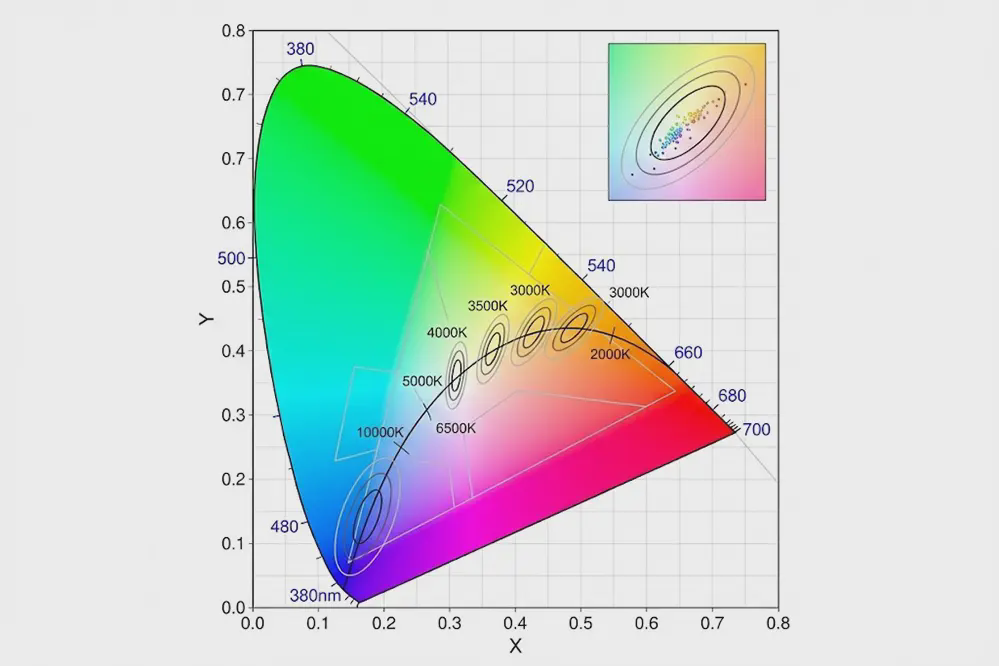
Color binning relies on sophisticated colorimetry—the science of how humans perceive color.
CIE 1931 Chromaticity Diagram
Developed by the International Commission on Illumination in 1931, the CIE chromaticity diagram maps all visible colors onto a two-dimensional X-Y coordinate system. For white LEDs, the relevant area is the Planckian locus—a curve representing colors produced by heating a theoretical "black body" to different temperatures.
Chromaticity coordinates describe where an LED's color point falls on this diagram. Two numbers—x and y—pinpoint the exact hue. This mathematical precision allows manufacturers to define exact color regions for binning instead of vague descriptions like "warm white."
MacAdam Ellipse Method
In the 1940s, Dr. David MacAdam conducted experiments to understand color perception thresholds. He had observers match color samples, adjusting them until they appeared identical. MacAdam discovered something important: the matches weren't perfect points—they fell within ellipse-shaped regions on the chromaticity diagram.
These MacAdam ellipses define zones where the human eye cannot reliably distinguish color differences. The size and orientation of these ellipses vary depending on location in the color space, but they provide a perceptually relevant way to define acceptable color variation.
The concept of "Just Noticeable Difference" (JND) emerged from this research. A JND occurs when 50% of observers can detect a color difference and 50% cannot. One MacAdam ellipse equals one JND.
For LED binning, manufacturers use MacAdam ellipses to define color tolerance zones. If all LEDs in a bin fall within the same MacAdam ellipse, most people won't perceive color differences between them—even though their exact chromaticity coordinates differ slightly.
SDCM (Standard Deviation of Color Matching)
Standard Deviation of Color Matching (SDCM) quantifies color consistency using MacAdam ellipse step sizes. The relationship is simple: 1 SDCM equals 1 MacAdam ellipse step.
Here's how different step sizes affect visual perception:
1 SDCM: Color differences are almost impossible to detect. Even trained lighting professionals struggle to see variations. This represents the tightest binning available commercially.
2 SDCM: Differences can be measured with instruments but remain barely visible to the human eye. Under controlled viewing conditions with trained observers, subtle variations might be detected.
3 SDCM: Small color differences become visible when fixtures are placed side-by-side and you're looking for differences. In normal viewing conditions, most people won't notice.
4 SDCM: Color differences are visible to most observers when LEDs are viewed together. Fixtures start to look noticeably different.
5-7 SDCM: Clear, distinct color differences that are immediately apparent. Multiple fixtures will obviously not match.
Research shows the human eye begins reliably detecting color differences at the 3-4 SDCM threshold. This is why premium architectural lighting typically specifies 2-3 SDCM binning, while general commercial applications accept 4-5 SDCM as adequate.
Understanding SDCM helps you specify appropriate tolerances. A 2-step MacAdam ellipse delivers near-perfect color matching but costs significantly more than a 5-step bin. The key is matching the tolerance to your application requirements.
Industry Standards for LED Binning
Multiple organizations have established standards to bring consistency to LED binning practices.
ANSI C78.377 Standard
The American National Standards Institute developed ANSI C78.377 to standardize color specifications for solid-state lighting. This standard defines nominal correlated color temperatures and creates chromaticity regions—parallelogram-shaped bins—for white LEDs.
Each ANSI color bin approximates a 7-step MacAdam ellipse centered on a target CCT. The 7-step tolerance was chosen to align with color variation consumers experienced with compact fluorescent lamps. Many LED manufacturers subdivide these ANSI bins further, with the "1/16 ANSI" approach dividing each standard bin into 16 smaller quadrangles for tighter control.
Hot-Testing at Junction Temperature
Traditional LED testing occurred at 25°C—convenient for manufacturing but far from real-world operating conditions. In actual applications, LED junction temperatures typically reach 65°C to 85°C or higher.
LED performance changes with temperature. As junction temperature increases, the dominant wavelength shifts, the color point moves, and light output decreases. An LED that tests perfectly at 25°C might perform quite differently at 85°C.
Forward-thinking manufacturers now employ hot-testing, binning LEDs at 85°C junction temperature to match typical application conditions. This dramatically improves performance predictability. Hot-testing also enables extremely tight color consistency that eliminates the need for complex color-targeting algorithms.
How LED Binning Enhances Lighting Design Efficiency
Predictable Performance in Installations
When you specify LEDs with known bin characteristics, you eliminate performance uncertainty. Your photometric calculations become reliable. Your power consumption predictions hold true. This predictability streamlines the design process. Instead of building in safety margins to account for unknown variation, you can design with confidence.
Consistent Visual Experience
In large commercial installations, visual consistency makes or breaks the project. Tight binning solves color variation problems. With 2-3 SDCM LEDs, every fixture matches. The lighting looks intentional, cohesive, and high-quality. This consistency protects brand identity in retail environments and delivers the premium experience clients expect.
Cost-Effective Project Planning
Understanding binning helps you optimize project budgets. Not every application needs 1-step SDCM binning. By matching tolerance to application requirements, you avoid over-specifying (wasting money) or under-specifying (risking quality issues).
Bin Range Selection: Cost vs. Quality Trade-offs
LED pricing correlates directly with bin tightness.
Wide Bin Ranges (5-7 SDCM)
Wide bins accept more LEDs from production runs, maximizing manufacturer yield. A 7-step MacAdam ellipse might include 80% or more of manufactured LEDs. This high yield translates to lower costs. For applications where color precision isn't critical—parking garages, warehouses, outdoor lighting—wide bins deliver adequate performance at attractive prices.
Tight Bin Ranges (1-3 SDCM)
Narrow bins require manufacturers to reject most LEDs from production. A 1-step MacAdam ellipse might capture only 5% of manufactured LEDs. A 2-step bin might reach 15%. This low yield drives higher pricing.
Tight binning makes sense when color precision matters: retail displays, hospitality lighting, architectural installations, museums, galleries, and high-end residential projects.
The Price-Performance Balance
1-2 SDCM: Premium applications where color matching is critical. Luxury retail, museum lighting, high-end hospitality, architectural showcases.
2-3 SDCM: Professional commercial applications with discerning viewers. Corporate lobbies, upscale retail, quality-focused residential.
3-5 SDCM: Standard commercial applications. Office lighting, retail back-of-house, educational facilities, healthcare.
5-7 SDCM: General purpose applications. Industrial facilities, warehouses, parking structures, outdoor security lighting.
Reading and Specifying Bin Codes
Bin Code Structure
Manufacturers typically use 3-4 character alphanumeric codes. While formats vary by manufacturer, the general structure follows a pattern:
First character: Luminous flux bin. Letters like J, K, L, M indicate different lumen output ranges.
Second and third characters: Color bin. Combinations like W0, U0, V0 identify chromaticity coordinate ranges.
Fourth character: Forward voltage bin. Letters such as D, E, F, G indicate voltage ranges.
For example, a Luxeon LED with bin code "YW0C" would have: Y (130-140 lumens), W0 (6000K cool white), C (2.79-3.03V).
Procurement Best Practices
Order full reels when consistency matters. LEDs are packaged on reels containing 1,000 to 2,000 units. All LEDs on a single reel come from the same bin—guaranteed consistency. Cut tape purchases draw from general inventory, potentially mixing bins.
Specify SDCM requirements clearly. State explicitly: "2-step MacAdam ellipse required" or "3 SDCM maximum" in purchase specifications.
Request bin code documentation. Ask suppliers to provide the specific bin codes used in your order. When you need to reorder years later, having the original bin codes ensures you can source matching LEDs.
Common Binning Challenges and Solutions
Challenge: "One Bin" Marketing Claims
Some manufacturers promote "one bin" LED products, implying superior consistency. But "one bin" is not standardized and can mean anything from a tight 2-step ellipse to a loose 5-step range.
Solution: Ignore marketing claims and request specific SDCM values. Ask: "What is the MacAdam ellipse step size?" Get the answer in writing.
Challenge: Mixing LEDs from Different Bins
Even with tight binning, mixing bins creates larger variations. Two 2-step bins might each be tightly controlled, but if centered on different target points, fixtures using LEDs from these different bins could be up to 4 steps apart.
Solution: Source all LEDs for a project from the same batch whenever possible. For large projects, coordinate with manufacturers to reserve sufficient inventory from a single production run.
Challenge: Color Drift Over Time
LEDs experience slight color shifts as they age. After 10,000+ hours of operation, you might notice subtle changes. Phosphor degradation and semiconductor aging gradually move the color point.
Solution: Start with tighter binning than minimally necessary. If your application could tolerate 4 SDCM variation, specify 2-3 SDCM. This provides buffer room for aging.
Challenge: Hidden Variation in Final Products
LED binning only addresses the chip itself. The final lighting product goes through additional manufacturing steps that can introduce variation. Different solder temperatures or inconsistent driver performance can cause identically binned LEDs to perform differently in finished products.
Solution: Choose manufacturers with comprehensive quality control that extends beyond just LED binning. Look for companies that test finished products, not just components.
Application-Specific Binning Requirements
Linear LED Strip Lighting (2-4 SDCM)
LED strips present unique challenges because every LED is visible in sequence. There's no averaging effect. When you light a cove or graze a wall with LED strips, any color variation shows immediately. For professional strip installations, 2-3 SDCM is the sweet spot.
Architectural Lighting (2-3 SDCM)
Architectural applications—wall washers, grazing fixtures, close-proximity downlights—require tight binning because fixtures are compared directly against each other within the same field of view. High-end hotels, luxury retail, and architectural showcases justify 2 SDCM investment.
General Commercial Lighting (3-5 SDCM)
Office buildings, schools, healthcare facilities, and standard retail can function well with 3-5 SDCM binning. In these environments, lighting serves primarily functional rather than aesthetic purposes. A 4 SDCM tolerance provides adequate uniformity while controlling costs.
Display and Signage (1-3 SDCM)
Retail displays, museum exhibits, gallery lighting, and high-end signage demand exceptional color accuracy. A jewelry store needs to show diamonds accurately. Slight color shifts can make merchandise look off-tone. These scenarios justify 1-2 SDCM specifications.
FAQ
Q1: What does a 3-step MacAdam ellipse mean for my project?
A 3-step MacAdam ellipse indicates that LEDs within the bin can vary by up to 3 SDCM steps from the target color point. This level provides good color consistency acceptable for most commercial applications, with differences barely noticeable to untrained observers.
Q2: Can I mix LEDs from different bins in one fixture?
Mixing LEDs from different bins is not recommended, as it creates noticeable color and brightness inconsistencies. Even mixing 2-step bins can result in fixtures that are 4-steps apart, creating visible differences in adjacent installations.
Q3: Why do tighter bin ranges cost more?
Tighter bins require manufacturers to discard more LEDs during sorting, reducing yield. A 1-step or 2-step bin may include only 5-15% of total production, while 7-step bins can use 80%+ of manufactured LEDs, directly impacting pricing.
Q4: How do I specify binning requirements for my lighting project?
Request specific SDCM values (e.g., "3-step MacAdam ellipse maximum") in procurement specifications. For critical applications, specify bin codes from datasheets and order full reels (1,000-2,000 LEDs) to ensure same-batch consistency.
Q5: Does LED binning affect the lifespan of LEDs?
Binning itself doesn't directly impact LED lifespan. However, proper binning ensures consistent performance throughout the system's life. Forward voltage binning also helps optimize driver efficiency, which can indirectly support longer operational life.
Q6: What's the difference between hot-testing and standard binning?
Hot-testing bins LEDs at 85°C junction temperature instead of the traditional 25°C. Since real-world LED applications typically operate at 65-85°C or higher, hot-testing provides performance specifications that match actual operating conditions, dramatically improving predictability.
Conclusion
LED binning transforms variable semiconductor components into predictable building blocks for professional lighting design. By understanding how manufacturers sort LEDs by color temperature, luminous flux, and forward voltage—and how MacAdam ellipses and SDCM measurements quantify these variations—you can specify appropriate tolerances for every application.
The key is matching binning tightness to application requirements. Architectural showcases and retail displays justify 1-2 SDCM investment for exceptional color precision. Commercial offices and educational facilities work well with 3-5 SDCM for cost-effective consistency. Industrial and outdoor applications can accept 5-7 SDCM when function matters more than aesthetics.
Specify SDCM requirements explicitly in procurement documents, order full reels for projects requiring color matching, and document bin codes for future reference. Remember that not every project needs 1-step binning, but the right projects absolutely justify the investment. Balance cost against quality requirements, and your lighting installations will deliver the consistent, professional performance your clients expect.